
History is a public good. Help us keep it that way.
World History Encyclopedia makes reliable history content freely available to all. Your year-end gift helps keep historical knowledge free from paywalls and accessible to learners everywhere.
$876 / $20000
Featured

Definition
Agora
The term agora (pronounced ah-go-RAH) is Greek for 'open place of assembly' and, early in the history of Greece, designated the area in a city where free-born citizens could gather to hear civic announcements, muster for military campaigns, or discuss politics. It later designated the open-air marketplace of a city. The agora of Athens is the best-known, though the term was used in other city-states for their public...
Featured

Article
Thanksgiving Day: A Brief History
The United States holiday of Thanksgiving is generally understood to be inspired by the harvest feast celebrated by the citizens of Plymouth Colony (later known as pilgrims...
Featured

Image
12 Renaissance Pigments That Shaped Masterpieces - Color, Trade & Materials in Renaissance Painting
During the Renaissance (c. 1400–1600), painters worked with pigments derived from minerals, metals, earths, plants, and...
Featured

Image
Fertile Crescent Map, Geography and Early Agriculture - From Foraging to Farming in the Ancient Near East
The Fertile Crescent is a modern geographical term introduced by American Egyptologist James Henry Breasted (Ancient...
Latest Content

Definition
Surrender at Appomattox - The End of the US Civil War
The Surrender at Appomattox Court House (9 April 1865) was an event most historians consider to mark the effective end of the American Civil War (1861-1865...

Article
The Siege of Vienna in 1529
The Siege of Vienna in 1529 was the first of the two major Ottoman campaigns against the European city of Vienna (the second siege occurred in 1683). The siege of 1529, which lasted...

Article
Swindling and Soldiering - Life in the Confederate Army
During the American Civil War, a soldier in the Confederate Army suffered as much from hunger as from long marches, illness, and lack of proper footwear, so...

Curriculum Collection
AP World History Unit 9 - Globalization (c. 1900 to the Present)
Over the course of the 20th century, the barriers of distance that had shaped all previous human history largely dissolved. Radio, air travel, container...

Curriculum Collection
AP World History Unit 8 - Cold War and Decolonization (c. 1900 to the Present)
After the end of the Second World War in 1945, two great powers held incompatible visions regarding the organization of societies. Over the...

Curriculum Collection
AP European History Unit 2 - Age of Reformation (c. 1450 to c. 1648)
Between 1450 and 1648, the religious unity of Western Christendom broke apart. In 1517, Martin Luther's challenge to the Church selling indulgences...
Free for the World, Supported by You
World History Encyclopedia is a non-profit organization. Please support free history education for millions of learners worldwide for only $5 per month by becoming a member. Thank you!
Become a MemberHistory should be free for everyone!
If you find World History Encyclopedia helpful, a $10 contribution helps keep trusted history free and accessible to millions of readers and students worldwide. Thanks for making a difference!
Donate $10Maps

Image
Map of the Four Voyages of Christopher Columbus, 1492–1504 - Atlantic Navigation & Early Spanish Colonization
The four voyages of Christopher Columbus between 1492 and 1504, sponsored by Queen Isabella I of Castile (reign...

Image
Map of the Battle of Britain, 1940 - Air Superiority, Radar & the Blitz, 1940–1941
The Battle of Britain (10 July – 31 October 1940) was a pivotal air campaign during World War II, fought between Britain's Royal Air Force...
Image
12 Renaissance Pigments That Shaped Masterpieces - Color, Trade & Materials in Renaissance Painting
During the Renaissance (c. 1400–1600), painters worked with pigments derived from minerals, metals, earths, plants, and...
For You

Article
Harappa: An Overview of Harappan Architecture & Town Planning
Harappa is a large village presently in the province of Punjab in Pakistan. The modern town is a part of and lies next to the ancient city. The site of...

Image Gallery
A Gallery of Monsters and Creatures of Greek Mythology
The myths and legends of ancient Greece included a wide variety of fearsome creatures and monsters, such as dragons, giants, demons, and multiformed beings...
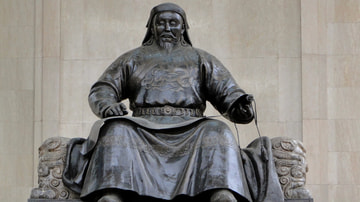
Definition
Kublai Khan
Kublai Khan (Qubilai-Qan) was the ruler of the Mongol Empire from 1260 to 1294. His accomplishments include establishing Mongol rule in China under the name of the Yuan Dynasty (1271-1368...

Definition
Atahualpa - Last of the Inca Rulers
Atahualpa (Atawallpa) was the last ruler of the Inca Empire. He reigned from 1532 until his capture and execution by the invading Spanish forces led by Francisco Pizarro in...
Book Reviews

Book Review
The Army of Alexander the Great
The Army of Alexander the Great (2025) is a highly detailed and insightful examination of one of the most influential military forces in history. Rather than presenting Alexander...

Book Review
Etruscan Civilization: A Cultural History
The Etruscans have long been a neglected civilization of the ancient Mediterranean and reading this book you will wonder how on earth that situation was ever allowed...

Book Review
Gone Viking III: The Holy Grail
Gone Viking III: The Holy Grail by Bill Arnott is a travel writing narrative with not just insight but also quirkiness gifted by the author. General enthusiasts and armchair...
Statistics
| 3,006 | definitions |
| 1,782 | articles |
| 19,957 | illustrations |
| 2,657 | videos |
| 415 | 3D images |
| 16,716 | translations |
| 48 | languages |
| 1,352 | contributors |
| 15,789 | keywords |
| 66,207 | registered users |
Ancient Period

Article
Sacred Sites & Rituals in the Ancient Celtic Religion
In the religion of the ancient Celts who lived in Iron Age Europe from 700 BCE to 400 CE, certain natural sites like springs, river sources, and groves were...

Definition
Silk in Antiquity
Silk is a fabric first produced in Neolithic China from the filaments of the cocoon of the silk worm. It became a staple source of income for small farmers and, as weaving techniques improved...

Definition
Ancient Celtic Pottery
The pottery of the ancient Celts, although produced over great distances in space and time, shares several common features no matter where it was made, illustrating that there was contact...

Article
A Visual Who's Who of Greek Mythology
Achilles The hero of the Trojan War, leader of the Myrmidons, slayer of Hector and Greece's greatest warrior, who sadly came unstuck when Paris sent a flying arrow guided...

Definition
Nicodemus
Nicodemus was an early follower of Jesus Christ, uniquely mentioned only in the fourth gospel, the Gospel of John. According to that gospel, he was a Pharisee and a member of the Sanhedrin (the...
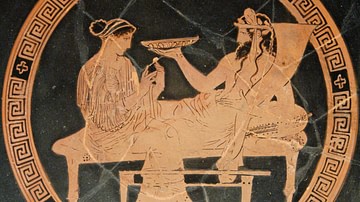
Definition
Persephone
Persephone (aka Kore) was the Greek goddess of agriculture and vegetation, especially grain, and the wife of Hades, the ruler of the Underworld. Persephone was an important element of the Eleusinian...

Article
The Mandate of Heaven and The Yellow Turban Rebellion
Throughout history, in order for a government to be respected and obeyed, it must possess some form of legitimacy recognized by the governed. Governmental systems...

Definition
Salado Culture
The Salado culture is a term used by historians and archaeologists to describe a pre-Columbian Southwestern culture that flourished from c. 1200-1450 CE in the Tonto Basin of what is now...
Medieval Period

Definition
King Arthur
King Arthur is among the most famous literary characters of all time. The Arthurian legend of the Knights of the Round Table, Camelot, the Quest for the Holy Grail, the love affair of Lancelot...

Definition
Kinkakuji
Kinkakuji Temple in Kyoto, Japan, more formally referred to as Rokuon-ji or 'Deer Garden Temple' and otherwise known as 'The Temple of the Golden Pavilion', was first built in 1397 CE. Originally...

Definition
Roger I of Sicily
Roger I, also known as Roger Bosso (c. 1031-1101) was a Norman knight and adventurer best known for conquering The Emirate of Sicily during the 11th century. His lifelong efforts helped...

Definition
Toyotomi Hideyoshi - Unifier of Japan
Toyotomi Hideyoshi (1537-1598) was a Japanese military leader who, along with his predecessor Oda Nobunaga (1534-1582) and his successor Tokugawa Ieyasu (1543-1616), is credited...

Definition
Richard II of England
Richard II of England reigned as king from 1377 to 1399 CE. The son of the late Edward the Black Prince (1330-1376 CE), Richard would succeed his grandfather Edward III of England (r...

Definition
Seventh Crusade
The Seventh Crusade (1248-1254 CE) was led by the French king Louis IX (r. 1226-1270 CE) who intended to conquer Egypt and take over Jerusalem, both then controlled by the Muslim Ayyubid...

Definition
Viking Warfare
Viking warfare, along with its key component of raiding, is inextricably connected with the expansion of Scandinavian influence along the North Atlantic and into the Mediterranean in the...
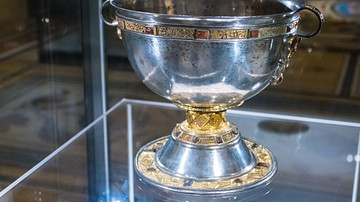
Definition
Derrynaflan Hoard
The Derrynaflan Hoard is a collection of Irish altar vessels dating between the 8th and 9th centuries CE. Discovered on the island of Derrynaflan, in the townland of Lurgoe, Co. Tipperary...
Early Modern Period

Article
Battles of Saratoga
The Battles of Saratoga (19 September and 7 October 1777) marked the climactic end of the Saratoga Campaign during the American Revolutionary War (1775-1783). The battles, which resulted...

Definition
Edo Period
The Edo period refers to the years from 1603 until 1868 when the Tokugawa family ruled Japan. The era is named after the city of Edo, modern-day Tokyo, where the Tokugawa shogunate had its government...

Definition
Józef Poniatowski
Prince Józef Poniatowski (1763-1813) was a Polish soldier and patriot, who served as commander-in-chief of the Polish army during the Napoleonic Wars (1803-1815). A steadfast ally of French...

Definition
Khotyn Fortress
Khotyn fortress is a complex of fortifications situated on the hilly right bank of the Dniester in Khotyn, Ukraine. It consists of a 13th-century stronghold and an 18th-century bastion surrounding...

Definition
Portuguese Malacca
The Portuguese colonised Malacca (modern Melaka) on the southwest coast of the Malay peninsula from 1511 and kept it until 1641 when the Dutch took over. The port controlled the Malay...

Article
The Ghost Wife
The Ghost Wife is a Pawnee story dealing with loss, grief, the inability to let go of the past, and the danger of dealing with ghosts. It reflects the Pawnee understanding of the unpredictable...

Definition
Portuguese Cochin
Cochin, located on the southwest coast of India, was a Portuguese colony from 1503 to 1663. Known to the Portuguese as Cochim, it was one of several important cities on India’s Malabar...
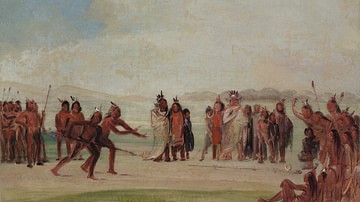
Definition
Chunkey
Chunkey (tchung-kee) is a Native American game involving a rolling disc (or ring) and two teams of players who score by throwing their sticks to land as close to the disc as possible. The game...
Modern Period

Article
Battle of the Thames
The Battle of the Thames (5 October 1813), or the Battle of Moraviantown, was a decisive engagement in the War of 1812, in which a US army under General William Henry Harrison defeated...

Article
Nih'a'ca Tales
Nih'a'ca tales are Arapaho legends concerning the trickster figure Nih'a'ca, who, according to Arapaho lore, is the first haxu'xan (two-spirit), a third gender, often highly regarded by many...

Article
Italian Colonialism in Libya
One of the most coveted projects of Italian colonial policy was to secure an African colony in the Mediterranean. For this reason, Italy fought and won the Italo-Turkish war of...

Definition
Frédéric Chopin
Frédéric Chopin (1810-1849) was a Polish composer and virtuoso noted for his solo piano music. Chopin's work helped make the piano the most popular musical instrument of the 19th century...

Article
The Red Eagles
The Red Eagles is a Cheyenne hero tale featuring the popular champion Mok-so-is, the child hero best known from the legend Found in the Grass, popular among many Algonquin-speaking nations...

Article
Battle of Rich Mountain - The Victory That Created an Army
The Battle of Rich Mountain (11 July 1861), fought in Randolph County, Virginia (now West Virginia) was the second Union victory attributed to Major General...

Article
Assassination of Abraham Lincoln
On the evening of 14 April 1865, US President Abraham Lincoln was shot in the back of the head by John Wilkes Booth, while attending a play at Ford's Theatre in Washington...

Article
Seven Sacred Rites of the Lakota Sioux
The Seven Sacred Rites of the Lakota Sioux (Seven Sacred Rites of the Lakota Oyate) are the spiritual observances of the Native American Sioux nation that maintain their...
Prehistoric Period

Definition
The Sweet Track
The Sweet Track is a Neolithic timber walkway, located in the Somerset Levels, England. It was originally part of a network of tracks built to provide a dry path across the marshy ground...

Definition
Homo Habilis
Homo habilis ("handy man") is an extinct species of human that lived in East and South Africa between 2.3 and 1.5 million years ago and plays an interesting role in the discussion surrounding...
Definition
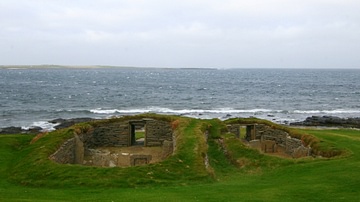
Knap of Howar
The Knap of Howar is a Neolithic site on the island of Papa Westray in Orkney, Scotland. The name is Old Norse for `mound of mounds' or `large barrow'. The building preserved at the site...

Definition
Woolly Mammoth
The woolly mammoth, Mammuthus primigenius, is an extinct herbivore related to elephants who trudged across the steppe-tundras of Eurasia and North America from around 300,000 years ago until...

Article
Origins of World Agriculture
Agriculture arose independently at several locations across the world, beginning about 12,000 years ago. The first crops and livestock were domesticated in six rather diffuse areas...

Article
The Dolmens of Sicily
It is a well-known fact that Sicily, the largest island in the Mediterranean sea, went through a quite complex prehistoric period. So much so that it is difficult to navigate through...

Image Gallery
A Gallery of Historical Maps
This gallery of 30 maps traces the history of cartography, with examples of maps made by cultures from the Paleolithic to the early modern period. The maps cover cities, states...

Definition
Ice Age
An ice age is a period in which the earth's climate is colder than normal, with ice sheets capping the poles and glaciers dominating higher altitudes. Within an ice age, there are varying pulses...
