
Search
Remove Ads
Advertisement

 This answer was generated by
 Search Results

Definition
Works and Days
Works and Days is an epic poem written in dactylic hexameter, credited to the 8th-century BCE Greek poet Hesiod. Hesiod is generally remembered for two epic works, Theogony and Works and Days but, like his contemporary Homer, he was part...

Definition
Theogony
The Theogony is an 8th-century BCE didactic and instructional poem, credited to the Greek poet Hesiod. The Theogony was, at first, not actually written down, rather, it was part of a rich oral tradition which only achieved written form decades...

Definition
Hesiod
Hesiod (c. 700 BCE) in conjunction with Homer, is one of those almost legendary early Greek Epic poets. His works are not of comparable length to Homer's. Hesiod's poems are not epic because of their length, but because of their language...

Article
Hesiod on the Birth of the Gods
The Greek poet Hesiod (c. 700 BCE) is most famous for his works Theogony and Works and Days. In this passage from Theogony, Hesiod relates the birth of the gods from cosmic Chaos and follows the lineage through the great Zeus, King of the...

Image
Polymnia - Muse of Hymns
A Roman statue of Polymnia, the Muse of hymns to the gods and heroes. 2nd century CE. (Ny Carlsberg Glyptotek, Copenhagen, Denmark)

Image
Head of Homeric Hero
This is a Roman marble version of a lost Hellenistic original. Another version of this head was found, together with the body, at Sprelonga, south of Rome. There, it belonged to a figure portraying a wineskin-carrier, in a group showing the...
Image
Theogony (Generations of the Gods) by Hesiod, c. 700 BCE
An infographic illustrating Hesiod's Theogony (literally meaning "Birth of the Gods") - the earliest known and the only complete account of the origins of the universe and the gods according to ancient Greek mythology and tradition. Traditionally...
Image
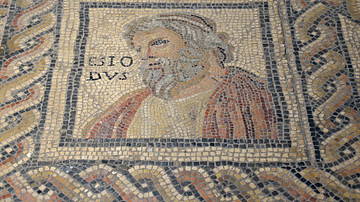
Portrait of Hesiod
Portrait of the Greek poet Hesiod (ESIODVS) on the Monnus mosaic from Augusta Treverorum (Trier), end of the 3rd century CE. It is the only known authenticated portrait of Hesiod. (Rheinisches Landesmuseum Trier, Germany)
Image
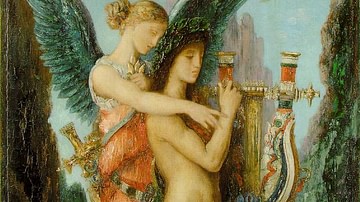
Hesiod and the Muse
Hesiod and the Muse,1891,oil on canvas by Gustave Moreau

Definition
Greek Dark Age
The Greek Dark Age (c. 1200 to c. 800 BCE, overlapping with the Iron Age, c. 1200-550 BCE) is the modern-day term for the period in Greek history following the Bronze Age Collapse when the Mycenaean Civilization fell and the Linear B writing...
