
Search
Remove Ads
Advertisement

 This answer was generated by
 Search Results

Definition
Nero - The Artist Emperor
Nero (37-68 CE) was the fifth Roman emperor, who reigned from 54 to 68 CE. The last emperor of the Julio-Claudian Dynasty, he came to power at the age of 16 with the help of his mother, Agrippina the Younger. Initially a popular ruler, his...

Definition
Ancient Greek Music
Music (or mousike) was an integral part of life in the ancient Greek world, and the term covered not only music but also dance, lyrics, and the performance of poetry. A wide range of instruments was used to perform music which was played...
Definition
Poppaea Sabina
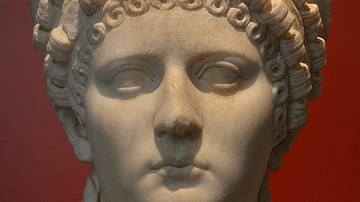
Poppaea Sabina (30-65 CE) was the wife of Praetorian prefect Rufrius Crispinius and then Marcus Salvius Otho (r. 69 CE) before she became the second wife of Roman emperor Nero (r. 54-68 CE). Considered by ancient sources both attractive and...

Definition
Agrippina the Younger
Julia Agrippina or Agrippina the Younger (6 November 15 - 19/23 March 59 CE) was a prominent woman during the early Roman Empire, niece to Tiberius (r. 14-37 CE) and Claudius (41-54 CE), whom she married, sister of Caligula (r. 37-41 CE...

Definition
Britannicus
Britannicus (41-55 CE) was the second child and only son born to the Roman emperor Claudius (r. 41-54 CE) and Valeria Messalina (c. 20-48 CE). Seen as a threat by Claudius' fourth wife, Agrippina the Younger (15-59 CE), and her son, the future...

Definition
Seneca
Lucius Annaeus Seneca (Seneca the Younger, l. 4 BCE - 65 CE) was a Roman author, playwright, orator, and most importantly a tutor and advisor to the Roman emperor Nero (r. 54-68 CE). Influenced by Stoic philosophy, he wrote several philosophical...

Article
Music & Dance in Ancient Egypt
Music and dance were highly valued in ancient Egyptian culture, but they were more important than is generally thought: they were integral to creation and communion with the gods and, further, were the human response to the gift of life and...
Definition
Roman Imperial Cult
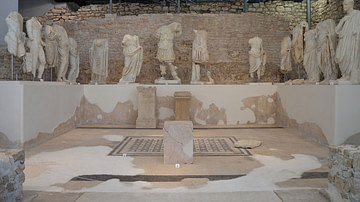
The Roman imperial cult was the practice of venerating Roman emperors and their families as having divine attributes, honoring their contributions to the spread of Roman religion and culture. It was instituted by the first Roman emperor Augustus...

Article
Nero's Golden House (Domus Aurea)
Nero's Golden House (the Domus Aurea) in Rome was a sumptuous palace complex which played host to the wild parties of one of Rome's most notorious emperors. Besides using the finest marble and decoration such as fine wall-painting and gilded...

Definition
Year of the Four Emperors - When Four Men Battled For Control of the Roman Empire
The Year of the Four Emperors (69 CE) was a brief period of political upheaval and civil war in the Roman Empire. In the aftermath of the death of Emperor Nero, four men – Galba, Otho, Vitellius, and Vespasian – were recognized as emperor...
