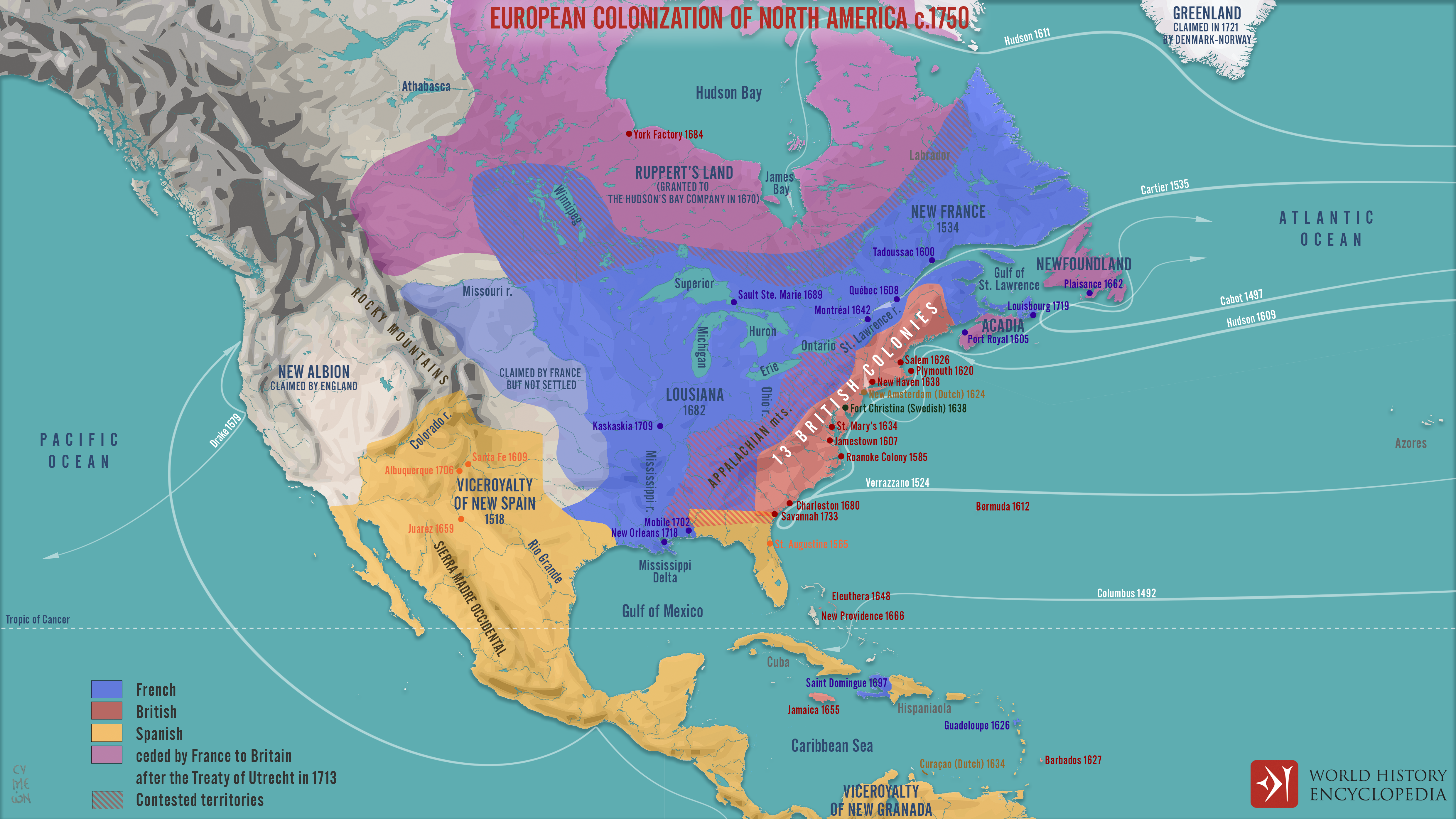
In this gallery of five maps, we examine the creation and expansion of the United States from the colonization of North America by European powers to the routes of the explorers who pushed ever westwards to the Pacific coast. Here we can trace the unstoppable geographical roots from which grew a nation that spread across a continent and established itself as the most powerful country on Earth.
The origins of the United States of America can be traced back to the early 17th century when European settlers, primarily from England, began establishing colonies along the eastern seaboard of North America. Over the next century, the 13 American colonies developed distinct identities and economies, with tensions with Britain escalating, particularly after the French and Indian War (1754-1763). This conflict, reshaping European alliances and burdening Britain financially, laid the groundwork for the American War of Independence.
In the 1760s and 1770s, a series of taxes imposed by the British Parliament further strained relations, ultimately leading to the American Revolution (1775-1783). The Continental Congress declared independence on July 4, 1776, and after the Revolutionary War, the Treaty of Paris in 1783 officially recognized the United States. The Constitution, ratified in 1788, established a federal system of government with a delicate balance of power. The early years were marked by westward expansion, industrialization, and territorial acquisition at the expense of indigenous populations. Despite challenges like sectionalism and the Civil War, the new nation persevered, evolving through periods of economic prosperity and social change.