
Search
Did you mean: Amenhotep III?
Remove Ads
Advertisement
Search Results

Article
The Gifts of Isis: Women's Status in Ancient Egypt
An inscription on an Egyptian papyrus dating from the 2nd century CE relates that the goddess Isis, bestowing gifts on humanity at the beginning of time, gave as much power and honor to women as she...

Article
The Magical Lullaby of Ancient Egypt
The Magical Lullaby (popularly known as Charm for the Protection of a Child) is an inscription from the 16th or 17th century BCE. The poem exemplifies the ancient Egyptian's personal religious and spiritual practices...

Article
Wonderful Things: Howard Carter's Discovery of Tutankhamun's Tomb
The great discoverer of the treasures of King Tutankhamun, Howard Carter, was born on May 9, 1874 CE to Samuel John and Martha Joyce (Sands) Carter in Kensington, England. A sick, home-schooled...

Video
Greatest Pharaohs of Egypt
This video depicts the reign of a few of the greatest Egyptian Pharaohs between 1350 and 1070 BCE (during the New Kingdom). It is one video in a series. It also displays examples of monuments and artworks that correspond...

Video
Egypt: New Kingdom
This video summarises the main events and developments of Egypt's New Kingdom.

Image Gallery
A Gallery of Tutankhamun & Family
Tutankhamun is easily the most famous Egyptian ruler in the world thanks to his nearly intact tomb discovered by Howard Carter in 1922 and the "mummy's curse" associated with the opening of that tomb. Although Tutankhamun...
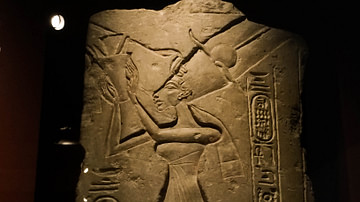
Image
Nefertiti Offering to the Aten
This Amarna Period limestone relief (ca. 1353-1336 BCE) depicts Queen Nefertiti offering a bouquet to the Aten. It is a prime example of the typical Amarna style, as it depicts the queen with an elongated face, slanted...
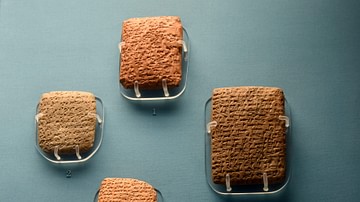
Image
The Amarna Letters
These clay tablets (letters) were found in the ruins of Akhenaten's capital, Tell el-Amarna, Egypt. They were inscribed with Babylonian cuneiform inscriptions, not hieroglyphs. The letters represent the diplomatic correspondence...

Image
The Colossi of Memnon
The Colossi of Memnon. Amenhotep III (1386-1353 BCE) commissioned them to stand guard over his mortuary complex at Luxor, Egypt. They are seventy feet high (21 metres), each weighing seven hundred tons.

Image
Scarab
Scarab shaped amulet containing the image and cartouche of Amenhotep III, promising its owner in this world 'life' (represented by an ankh). These beetle amulets were used in Ancient Egypt for rituals or administrative purposes (14th...
