
Search
Remove Ads
Advertisement
Search Results

Definition
Magi
The Magi are the visitors who came to Bethlehem to worship the newly-born Jesus of Nazareth in the gospel of Matthew (2:1-2). 'Magi' is a transliteration of the Greek magos from old Persian magus ("powerful") as a reference to the Zoroastrian...
Definition
Hosea
Hosea is listed as the first of the twelve minor prophets in the Hebrew Bible. He was active in the 8th century BCE and his ministry extended over 60 years, from King Jeroboam II (787-747 BCE) to King Hoseah (731-722 BCE). He was one...

Definition
Claude Brousson
Claude Brousson (l. 1647-1698) was a prolific writer and famous preacher after the revocation of the Edict of Nantes in 1685 when Protestantism was outlawed in France. He self-exiled to Lausanne and Holland and returned to France...

Article
Legacy of the Ancient Romans
The legacy of the ancient Romans – from both the time of the Roman Republic (509-27 BCE) and the time of the Roman Empire (27 BCE - 476 CE) – exerted a significant influence on succeeding cultures and is still felt around...
Article
Ghosts in Ancient Japan
Ghosts (obake or yurei) appear in ancient Japanese folklore and literature, usually in moral tales designed to both warn and entertain but they were also an important element of ancestor worship. If the deceased members...

Article
Nativity of Jesus
The nativity of Jesus of Nazareth is told in the gospels of Matthew and Luke. In Christian theology, the existence of two nativity stories by two different writers provided a prooftext for the historicity of the event. However...

Article
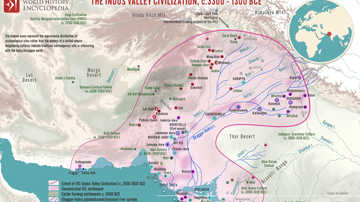
Early Judaism
During the period of early Judaism (6th century BCE - 70 CE), Judean religion began to develop ideas which diverged significantly from 10th-to-7th-centuries BCE Israelite and Judean religion. In particular, this period marks a significant...
Article
Religious Developments in Ancient India
For well over 1,000 years, sacred stories and heroic epics have made up the mythology of Hinduism. Nothing in these complex yet colourful legends is fixed and firm. Pulsing with creation, destruction, love...
Article
The Temple in Jerusalem
According to Jewish tradition, the original Jerusalem Temple was ordained by Yahweh/God, as described in 2 Samuel 7:12, where Yahweh commands Nathan to tell David: When your days are fulfilled and you lie down with your...

Article
Byzantine Icons
Icons, that is images of holy persons, were an important part of the Byzantine Christian Church from the 3rd century CE onwards. Venerated in churches, public places, and private homes, they were often believed to have protective...
