
Search
Did you mean: Fayum?
Remove Ads
Advertisement
Search Results

Definition
Field of Reeds (Aaru)
A'Aru (The Field of Reeds) was the Egyptian afterlife, an idealized vision of one's life on earth (also known as Sekhet-A'Aru and translated as The Field of Rushes). Death was not the end of life but a transition to another...

Definition
Hathor
Hathor is an ancient Egyptian goddess associated, later, with Isis and, earlier, with Sekhmet but eventually was considered the primeval goddess from whom all others were derived. She is usually depicted as a woman with the head of a...

Definition
Egyptian Obelisk
An obelisk is a stone rectangular pillar with a tapered top forming a pyramidion, set on a base, erected to commemorate an individual or event and honor the gods. The ancient Egyptians created the form at some point in the Early...

Definition
Serket
Serket (also known as Serqet, Selkis, and Selket) is an Egyptian goddess of protection associated with the scorpion. She was worshipped widely in Lower Egypt as a great Mother Goddess in the Predynastic Period (c. 6000- c. 3150 BCE) and...

Definition
Pi-Ramesses
Pi-Ramesses (also known as Per-Ramesses, Piramese, Pr-Rameses, Pir-Ramaseu) was the city built as the new capital in the Delta region of ancient Egypt by Ramesses II (known as The Great, 1279-1213 BCE). It was located at the site...

Article
Women in Ancient Egypt
Women in ancient Egypt were regarded as the equals of men in every aspect save that of occupation. The man was the head of the household and nation, but women ran the home and contributed to the stability of that nation as...
Article
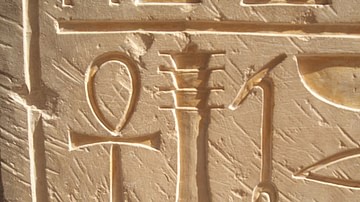
Ancient Egyptian Symbols
Religion in ancient Egypt was fully integrated into the people's daily lives. The gods were present at one's birth, throughout one's life, in the transition from earthly life to the eternal, and continued their care for...

Article
The Lamentations of Isis and Nephthys
The Lamentations of Isis and Nephthys is an ancient Egyptian text in which the two goddess-sisters call the soul of the god Osiris to rejoin the living. The poem takes the form of a call-and-response liturgy and...

Definition
New Kingdom of Egypt - The Age of Empire
The New Kingdom (circa 1570 to circa 1069 BCE) is the era in Egyptian history following the disunity of the Second Intermediate Period (circa 1782-1570 BCE) and preceding the dissolution of the central government...

Definition
Middle Kingdom of Egypt - Ancient Egypt's Classical Age
The Middle Kingdom (2040-1782 BCE) is considered ancient Egypt's Classical Age, during which it produced some of its greatest works of art and literature. Scholars remain divided on which dynasties...
