
Search
Did you mean: Hestia?
Remove Ads
Advertisement
Search Results
Article
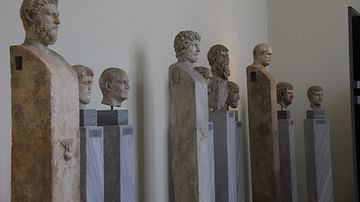
The Desecration of the Statues of Hermes, 415 BCE
On 7 June 415 BCE, various statues of the god Hermes were desecrated in Athens. The Peloponnesian War (431-404 BCE) had been raging for decades as one of the biggest civil wars in Ancient Greece, and...
Article
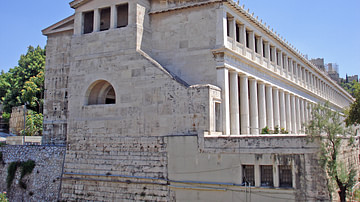
Athens in the Hellenistic World
When we think about ancient Athens, it is almost always about the classical city. We think of such things as its numerous monuments (the Parthenon on the Acropolis for example), beautifying everywhere, the Agora swarming...

Article
The Delian League, Part 4: The Ten Years War (431/0-421/0 BCE)
This text is part of an article series on the Delian League. The fourth phase of the Delian League encompasses the first part of the Great Peloponnesian War, also referred to as the Ten Years...

Article
Pausanius' Guide To Ancient Athens
Pausanius (l. 110-180 CE) was a geographer and historian who traveled extensively, taking notes on points of interest, then wrote on them in guide books which could be used by tourists visiting the sites described...

Article
Museums in the Ancient Mediterranean
Museums have been around much longer than one might think, but in the ancient world, they were principally institutions of research and learning rather than places to display artworks and artefacts, even if they...

Article
The Life of Crates of Thebes in Diogenes Laertius
Crates of Thebes (l. c. 360-280 BCE) was one of the most important Cynic philosophers of ancient Greece. He was born to a wealthy family in Thebes but gave away his inheritance after realizing the futility...

Image
Odysseus blinding the Cyclops
Attic black-figure skyphos depicting Odysseus blinding the sleeping Cyclops Polyphemus, by the Theseus Painter, from Boeotia (Greece), 490-480 BCE. (Altes Museum, Berlin)

Image
Terracotta Figurine of a Baking Woman
Terracotta figurine of a woman kneading pieces of bread or pancake, c. 500-475 BCE. National Archaeological Museum, Athens. This clay statuette shows a woman baking bread as one of her daily chores. That she...

Image
Black-figure Kantharos
A black-figure kantharos (drinking cup) depicting Hercules and centaurs. From Boeotia, c. 550 BCE. (Antikensammlungen, Munich).
Image
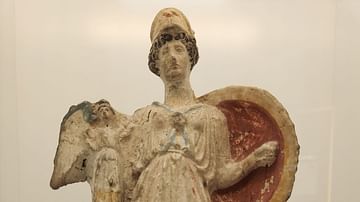
Boeotian Figurine of Athena
A rare polychromatic terracotta version of the chryselephantine statue of Athena Parthenos, which stood in the Parthenon and was a work of Pheidias, of the years 447/6-438 BCE. Perhaps from Vathy, Avlis District, Boeotia...
