
Search
Remove Ads
Advertisement
Search Results

Article
The Search for the Source of the Nile - Solving Geography's Last Great Riddle
The search for the source of the Nile River was one of the last great geographical mysteries of 19th-century European exploration. Men like Livingstone, Burton, Speke, and Stanley...

Definition
Gaiseric
Gaiseric (r. 428-478 CE, also known as Genseric and Geiseric) was the greatest king of the Vandals who remained undefeated from the time he took the throne until his death. He was probably born in 389 CE near Lake Balaton (present-day...
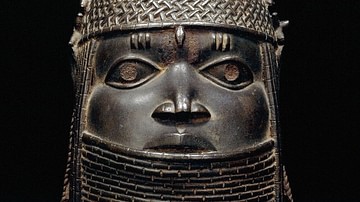
Collection
The Empires of West Africa
The ancient and medieval Mediterranean might have been a bustling stage of ever-changing empires but, across the inhospitable barrier of the Sahara Desert, West Africans were equally busy building up and toppling down...

Definition
Wolof Empire
The Wolof (aka Jolof or Djolof) Empire was a state on the coast of West Africa, located between the Senegal and Gambia rivers, which thrived from the mid-14th to mid-16th century CE. The empire prospered on trade thanks to the two...

Definition
Kingdom of Benin
The Kingdom of Benin, located in the southern forests of West Africa (modern Nigeria) and formed by the Edo people, flourished from the 13th to 19th century CE. The capital, also called Benin, was the hub of a trade network exclusively...

Image
Modern Map of Central America
A map of modern Central America.

Definition
Vandals
The Vandals were a Germanic tribe who are first mentioned in Roman history in the Natural History of Pliny the Elder (77 CE). The Roman historian Tacitus also mentions them in his Germania (c. 98 CE), though he also refers to them as...

Image
Map of Africa in World War II
Africa became a central arena in the global struggle of the Second World War (1939–1945), where imperial rivalry, strategic geography, and colonial governance converged. Campaigns in North Africa (1940–1943) pitted...

Definition
Portuguese Empire
The Portuguese Empire was established from the 15th century and eventually stretched from the Americas to Japan. Very often a string of coastal trading centres with defensive fortifications, there were larger territorial colonies...
Image
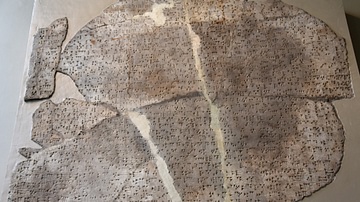
Door Slab from the Central Palace, Nimrud
These cuneifrom inscriptions describe some of the military campaigns of the Assyrian king Tiglath-pileser III (reigned 744-727 BCE) and were probably first placed in a doorway of the Central Palace built by...
