
Search
Did you mean: God?
Remove Ads
Advertisement
Search Results
Image
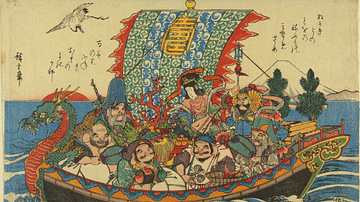
Seven Lucky Gods on Takarabune
The Seven Lucky Gods (aka Shichifukujin) of Japanese folklore on their treasure ship or takarabune. By Hiroshige (1797-1858 CE). Woodblock print, c. 1840 CE. (Victoria & Albert Museum, London)
Image
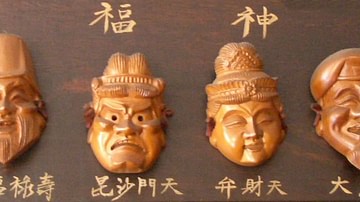
Seven Lucky Gods
The Seven Lucky Gods or Shichifukujin of Japanese folklore. From left to right: Soldan Sağa Hotei, Juroujin, Fukurokuju, Bishamonten, Benzaiten, Daikokuten, Ebisu

Definition
Religion in the Ancient World - Order and the Spiritual Experience
Religion (from the Latin Religio, meaning "restraint," or Relegere, according to Cicero, meaning "to repeat, to read again," or, most likely, Religionem, "to show respect for what is sacred"...

Image
The Twelve Olympian Gods of Ancient Greece
The Twelve Olympian Gods (Greek: Δωδεκάθεον, Dodekatheon) represent the core pantheon of ancient Greek religion, embodying divine authority over the natural world, human affairs, and cosmic order. Traditionally...

Image
Theogony (Generations of the Gods) by Hesiod, c. 700 BCE
An infographic illustrating Hesiod's Theogony (literally meaning "Birth of the Gods") - the earliest known and the only complete account of the origins of the universe and the gods according to...

Definition
Mesopotamian Religion - Daily Life as a Form of Worship
Mesopotamian religion was central to the people's lives. Humans were created as co-laborers with their gods to hold off the forces of chaos and to keep the world running smoothly. As in ancient Egypt...

Video
Seven Japanese Gods of Luck Festival (Shichifukujin) - Hatsu Konpira
At Kotohiragu Shrine a small shrine in Tokyo, they have a small festival with a small parade of the Shichifukujin, the Seven Lucky Gods of Japan. Hatsu Konpira is the shrine's first fair...

Definition
Shinto
Shinto means 'way of the gods' and it is the oldest religion in Japan. Shinto's key concepts include purity, harmony, family respect, and subordination of the individual before the group. The faith has no founder or prophets and there...

Video
Japanese Mythology | Izanagi and Izanami and the Birth of Gods | LittleArtTalks
The creation story of Japan illustrated with Japanese Art. The birth of the gods Izanagi, Izamani, Amaterasu, Tsukuyomi, and Takehaya Susanoo, and why the emperor is divine...

Video
The Birth of the Gods - The Ancient Greek Creation Myth
A cosmogony is a creation myth, a myth that explains how the universe as we know it came into existence and is a type of story found in most, if not all, cultures that have surviving literature...
