
Search
Remove Ads
Advertisement
Search Results

Image Gallery
A Gallery of Ancient Egyptian Art
Ancient Egyptian art was created to serve a practical purpose, not for its own sake, and so every piece had a specific function. At the same time, these works were crafted in accordance with the cultural value of...
Image
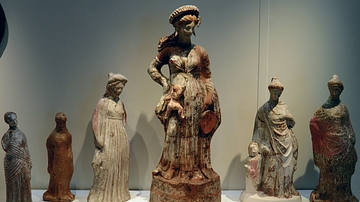
Hellenistic Terracotta Figurines from Pella
Terracotta figurines of women with their ordinary clothes and adornments, 2nd century BCE (Pella Archaeological Museum).

Interview
Interview: Bejeweled Sri Lanka
The first comprehensive survey of Sri Lankan art organized by an American museum, The Jeweled Isle: Art from Sri Lanka, on show now at the LACMA in Los Angeles, California, presents some 250 works addressing nearly...

Image Gallery
A Gallery of Chinese Art & Architecture
Chinese culture developed from small communities such as Banpo Village (c. 4500 BCE) through the early Xia Dynasty (c. 2070-1600 BCE) and the great dynastic periods that followed after, creating some of the...
Image
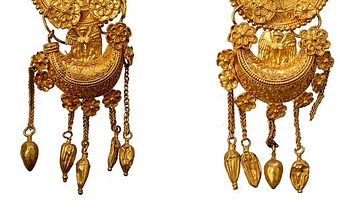
Hellenistic Gold Earrings
A pair of Hellenistic gold earrings, 4th century BCE. Found in tomb II of Mogilanska Mogila tumulus at Vratsa. (Regional Historical Museum, Vratsa, Bulgaria)
Photography: Regional Historical Museum, Vratsa, Bulgaria.
Image
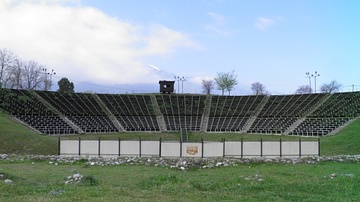
Dion Hellenistic Theatre, Greece
The Hellenistic Theatre at Dion in Macedon with Mount Olympus in the background. The theatre was built into a natural hill during the 3rd century BCE. It underwent several phases of modification during the reign of...
Image
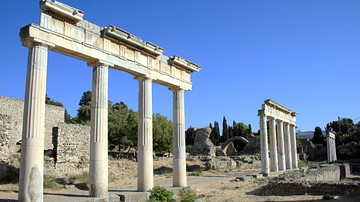
The Hellenistic Gymnasium, Kos
The remaining columns of the Hellenistic period gymnasium, Kos.
Image
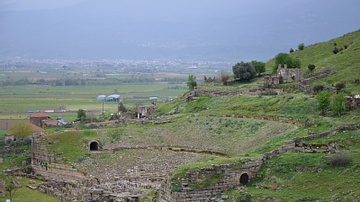
The Hellenistic Theatre of Alabanda
The Hellenistic theatre of Alabanda, located on a natural south-facing hillside. The theatre could hold 6,000 spectators in its early phase. In the Imperial period, gladiator and animal combats were increasingly...

Image
Hellenistic Gate, Butrint
A gate entrance in the Hellenistic fortification walls of Butrint (modern Albania), 2nd century BCE. Constructed using large ashlar blocks with angled joins designed to minimise earthquake damage. Despite this precaution...
Image
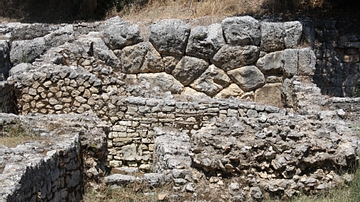
Hellenistic Walls, Butrint
A detail of the Hellenistic fortification walls of Butrint (modern Albania) employing large polygonal blocks. 2nd century BCE.
