
Search
Remove Ads
Advertisement
Search Results

Definition
Upanishads
The Upanishads are the philosophical-religious texts of Hinduism (also known as Sanatan Dharma meaning “Eternal Order” or “Eternal Path”) which develop and explain the fundamental tenets of the religion. The name is translated as...
Image
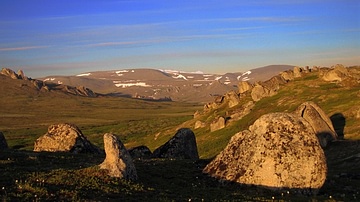
Bering Land Bridge Natural Preserve
Bering Land Bridge Natural Preserve. Many parts of this area look similar to how it may have looked when the first humans arrived there, perhaps around 30,000 years ago. From there on, early humans may have crossed...

Definition
Thomas Hobbes
Thomas Hobbes (1588-1679) was an English philosopher who famously summarised his pessimistic view of human nature in his greatest work, Leviathan, published in 1651. Hobbes believed that the life of humanity in the state of nature...

Definition
Andreas Vesalius
Andreas Vesalius (1514-1564) was the most celebrated anatomist in Europe during the 16th century and a key figure of the Scientific Revolution. Vesalius' great work was his On the Fabric of the Human Body, which contains over...

Definition
Germ Theory
The germ theory, which emerged in the late 19th century, demonstrated that microscopic germs caused most human infectious diseases. The germs involved included bacteria, viruses, fungi, protozoa, and prions. Louis Pasteur (1822-1895...

Definition
Renaissance Humanism
Renaissance Humanism was an intellectual movement typified by a revived interest in the classical world and studies which focussed not on religion but on what it is to be human. Its origins went back to 14th-century Italy...

Article
New Gilgamesh Fragment: Enkidu's Sexual Exploits Doubled
Sometimes it is the smallest discoveries that have the largest impact. When Alexandra Kleinerman and Alhena Gadotti found a new fragment of the Epic of Gilgamesh in 2015 CE, it did not seem to be...

Definition
Kon-Tiki Expedition - Thor Heyerdahl's Epic Crossing of the Pacific in a Raft
The Kon-Tiki expedition of 1947, led by the Norwegian Thor Heyerdahl (1914-2002), successfully crossed 8,000 km (5,000 miles) of the Pacific Ocean from Peru to the Tuamotu Islands...

Image
Map of the Sassanid Empire c. 620 CE - Persia’s Last Great Imperial Power
The Sasanian Empire (224–651 CE), known in Middle Persian sources as Ērānshahr (“Realm of the Iranians”), emerged as the final pre-Islamic Persian imperial state and a major power of...

Image
Map of the Kingdom of the Vandals (435–534 CE)
The Kingdom of the Vandals and Alans (435–534 CE) emerged as one of the most significant post-Roman states in the western Mediterranean. Founded after the Vandals, a Germanic people originally from Central...
