
Search
Did you mean: Assur?
Remove Ads
Advertisement
Search Results

Definition
Mosaic
Mosaics are designs and images created using small pieces (tesserae) of stone or other materials which have been used to decorate floors, walls, ceilings, and precious objects since before written records began. Like pottery, mosaics...
Definition
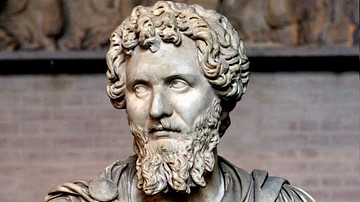
Septimius Severus
Lucius Septimius Severus was Roman emperor from April 193 to February 211 CE. He was of Libyan descent from Lepcis Magna and came from a locally prominent Punic family who had a history of rising to senatorial as well as consular...

Definition
Seleucus I Nicator
Seleucus I Nicator (l. c. 358-281 BCE, r. 305-281 BCE) was one of the generals of Alexander the Great (l. 356-323 BCE) who made up the group of Diadochi ("successors") who divided the vast Macedonian Empire between them after...

Definition
Antigonus I
Antigonus I Monophthalmus ("the One-Eyed") (382 -301 BCE) was one of the successor kings to Alexander the Great, controlling Macedonia and Greece. When Alexander the Great died in 323 BCE, a conflict known as the Wars of the Diadochi...

Definition
Argead Dynasty
The Argead dynasty, the ancient Macedonian house of Dorian Greek origin, lasted from the 7th century to 310 BCE. The mythological founder of the dynasty was King Caranus but it was under Philip II of Macedon (382-226 BCE) that...

Definition
Battle of Pydna
The Battle of Pydna in June 168 BCE was a decisive Roman victory that ended the Third Macedonian War and established Rome as the dominant power in the Mediterranean. The Roman Republic was expanding, enlarging its sphere of influence...

Definition
Perdiccas
Perdiccas (d. 321 BCE) was one of Alexander the Great's commanders, and after his death, custodian of the treasury, regent over Philip III and Alexander IV, and commander of the royal army. When Alexander the Great crossed the Hellespont...

Definition
Amastris
Amastris (c. 340/39-285 BCE) was a niece of the Persian king Darius III (r. 336-330 BCE) through her father Oxyathres. She was married in succession to Alexander's general Craterus, the tyrant Dionysius of Heraclea, and finally to Lysimachus...
Definition
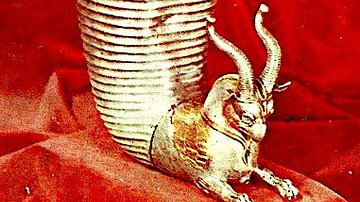
Orontid Dynasty
The Orontid dynasty (aka Eruandid or Yervanduni) succeeded the Kingdom of Urartu in ancient Armenia and ruled from the 6th to 3rd century BCE. Initially, the Orontids ruled as Persian satraps and the culture, language and political...

Image
Map of Alexander the Great's Conquests
A map showing the route that Alexander the Great took to conquer Egypt, Mesopotamia, Persia, and Bactria.
