
Search
Did you mean: Mosaic?
Remove Ads
Advertisement
Search Results
Article
The Report of Wenamun & the Perils of Living in the Past
The Report of Wenamun (also known as The Tale of Wenamun or The Report of Wenamon) is an Egyptian literary work dated to c. 1090-1075 BCE toward the end of the New Kingdom (c.1570 - c. 1069 BCE...

Image Gallery
A Gallery of 20 Mummies from around the World
Mummification is the natural or artificial preservation of the soft tissue of a dead body. Natural mummification can happen in extremely cold, dry, or anaerobic conditions. Perhaps the most famous example...

Image
Map of Europe Before the Fall of Constantinople, c. 1450 - Political Europe and the Eastern Mediterranean
Around 1450 CE, Europe and the eastern Mediterranean stood at the intersection of declining medieval powers and emerging regional states. The Byzantine Empire...

Image
Hammurabi's Law Code
A diorite stele with an inscription of Hammurabi's code of laws. Susa, Babylonia, 18th century BCE. Cast of the original now in the Louvre, Paris. (Pushkin Museum, Moscow)

Image
The Vladimir Icon
The Byzantine icon of the Virgin and Child known as the Vladimir Icon, painted c. 1131 CE in Constantinople. Restoration following fire damage means that only the faces are original. (Tretyakov Gallery, Moscow)

Image
Map of the Russian Revolution of 1905
This map illustrates the Russian Revolution of 1905, a wave of political and social unrest across the Russian Empire following defeat in the Russo-Japanese War (1904-5). The revolution was sparked by Bloody Sunday...
Image
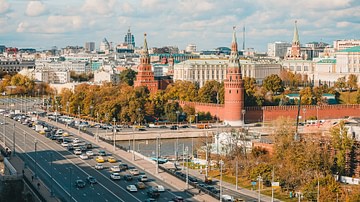
The Kremlin from the House on the Embankment
The view of the Moscow Kremlin from the balcony of the House on the Embankment. Photo taken in 2019 by photographer Semyon Borisov.

Image
Roman School
A teacher with three discipuli, relief found in Neumagen near Trier, c. 180-185 CE. Photo of casting in Pushkin Museum, Moscow.
Image
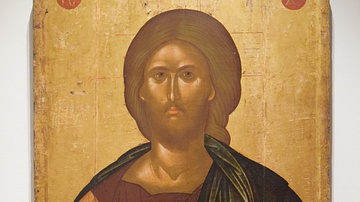
Icon of Christ Pantokrator
This icon was painted on wood in Constantinople in the second quarter of the 15th century CE during the waning days of the Byzantine Empire. It was likely made at one of the imperial workshops, and it depicts Jesus Christ...
Image
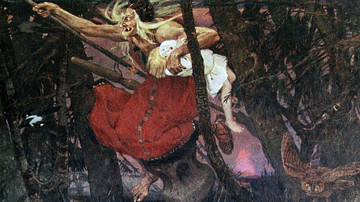
Baba Yaga by Vasnetsov
A painting portraying Baba Yaga. According to Slavic folklore, Baba Yaga was a witch who often preys on children to eat them. However, some accounts present her as a wise and helpful creature. The painting was created in...
