
Search
Remove Ads
Advertisement
Search Results

Definition
Meroë
Meroe was a wealthy metropolis of the ancient kingdom of Kush in what is today the Republic of Sudan. It was the later capital of the Kingdom of Kush (c. 1069 BCE to c. 350 CE) after the earlier capital of Napata was sacked c. 590 BCE...

Definition
Empress Theodora
Theodora reigned as empress of the Byzantine Empire alongside her husband, Emperor Justinian I, from 527 CE until her death in 548 CE. Rising from a humble background and overcoming the prejudices of her somewhat disreputable...
Definition
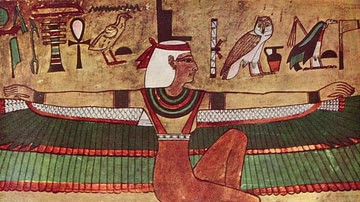
Isis
Isis is an ancient Egyptian goddess who became the most popular and enduring of all the Egyptian deities. Her name comes from the Egyptian Eset, ("the seat") which referred to her stability and also the throne of Egypt as she was considered...

Definition
Horus
Horus is the name of a sky god in ancient Egyptian mythology which designates primarily two deities: Horus the Elder (or Horus the Great), the last born of the first five original gods, and Horus the Younger, the son of Osiris and Isis...

Definition
Baal
Baal (also given as Ba'al) is a Canaanite-Phoenician god of fertility and weather, specifically rainstorms. The name was also used as a title, however, meaning "Lord" and was applied to a number of different deities throughout the ancient...

Definition
Thutmose III
Thutmose III (also known as Tuthmosis III, r. 1458-1425 BCE) was the 6th king of Egypt's 18th Dynasty, one of the greatest military leaders in antiquity, and among the most effective and impressive monarchs in Egypt's history. His...

Definition
Egyptian Book of the Dead
The Egyptian Book of the Dead is a collection of spells which enable the soul of the deceased to navigate the afterlife. The famous title was given the work by western scholars; the actual title would translate as The...

Definition
Library of Ashurbanipal
The Library of Ashurbanipal (7th century BCE) is the oldest known systematically organized library in the world, established in Nineveh by the Neo-Assyrian king Ashurbanipal (r. 668-627 BCE) to preserve the history and culture...

Definition
Clovis I
Clovis I (or Chlodovech, 466-511/513 CE), king of the Franks, is considered the founding father of the Merovingian Dynasty, which would continue for over 200 years. Clovis became king at the age of 15, and by the time of his death 30...
Definition
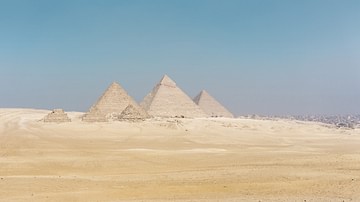
Pyramid
A pyramid is a structure or monument, usually with a quadrilateral base, which rises to a triangular point. In the popular imagination, pyramids are the three lonely structures on the Giza plateau at the edge of the Sahara Desert but...
