
Search
Remove Ads
Advertisement
Search Results

Article
Key German Weapons of World War I
Superior weapons can win wars, and during the First World War (1914-18) all sides attempted to gain an advantage over the enemy by producing more and more destructive devices that could be used effectively on land...

Article
The Christian Concept of Human Sexuality as Sin
In the ancient world, human sexuality was crucial for the survival of the tribe and clan as well as pleasurable, a gift from the gods. Thousands of native cults emphasized fertility through rituals and...

Article
Philo of Byzantium's On the Seven Wonders
Philo of Byzantium's On the Seven Wonders (225 BCE) is the first known list of the Seven Wonders of the Ancient World (though it may have been based on earlier works now lost). Philo's list differs from the...

Article
New Testament Text-Types
The books of the New Testament were written in the 1st century CE. As Christianity spread in the 2nd century CE, many copies were made, some by non-professionals. Early manuscripts are considered to be closer to the original...
Article
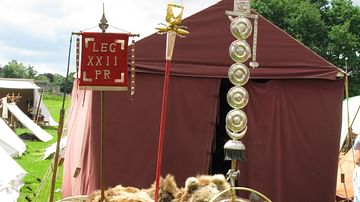
Legions of the Rhine Frontier
After Julius Caesar’s (100-44 BCE) conquest of Gaul, Roman legions pushed the borders of the Roman Empire’s frontier to the banks of the Rhine River. Augustus (r. 27 BCE - 14 CE) divided the newly acquired region into...

Article
Psychological Intimidation at the Battle of Carrhae
Psychological intimidation in military conflict has been an art of war since ancient times. Employing misinformation, feigned movements, subtle messaging, and overt display of aggression, its employ...

Article
First Days in the Union Army - Recruitment and Training in the Civil War
Recruitment and training practices during the American Civil War varied according to the year, the commanding officer, and between the opposing forces, but followed the same basic model...

Image
Roman Victory Procession
Artist's impression of a victory procession. This 3D render nicely displays how Roman soldiers have looked, and how their victories were celebrated.

Image
Section of the Sweet Track
Section of the "Sweet Track" walkway now in the British Museum.
From England - 3807/3806 BCE

Definition
Indus Valley Civilization
The Indus Valley Civilization was a cultural and political entity which flourished in the northern region of the Indian subcontinent between c. 7000 - c. 600 BCE. Its modern name derives from its location in the valley...
