
Search
Remove Ads
Advertisement
Search Results

Article
Scribes in Ancient Mesopotamia - The Beginning of History
Scribes in ancient Mesopotamia were highly educated individuals trained in writing and reading on diverse subjects. Initially, their purpose was to record financial transactions through trade, but...

Article
Lost Treasures From Iraq: Revisited & Identified
For how long do we build a household? For how long do we seal a document? For how long do brothers share the inheritance? For how long is there to be jealousy in the land(?)? The Epic of Gilgamesh...

Image
Detail of the War Scene of the Standard of Ur Showing Sumerian Warriors
This is a detail of the so-called "War Scene" of the Standard of Ur. This detail is part of the left half of the middle register. Here, six Sumerian soldiers stand and stride to the...

Image
The Weld-Blundell Prism Version of Sumerian King List
The Weld-Blundell Prism, the most complete version of the Sumerian King List extant, from Larsa, c. 1827-1817 BCE.
Ashmolean Museum, Oxford.

Image
Cuneiform Tablets in Sumerian
Carved stone cuneiform tablets in Sumerian.
Left: Temple of Ningirsu, Girsu. Right: Temple of Nindara, Ur. Dating around 2141-2122 BCE.
Image
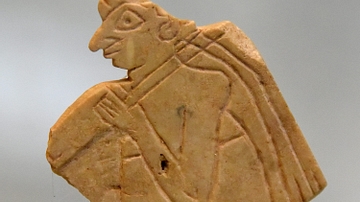
Sumerian Man Holding a Pole
This fragment of a stone inlay was found in Kish. It depicts an incised design of a man wearing the typical Sumerian long robe, carrying a pole on his shoulder. This is probably from a battle scene. The overall depiction...

Image
Sumerian Worshipper Statue
A statue of a Sumerian worshipper. Marble, early dynastic period, 2800-2300 BCE, Mesopotamia, Sulaimaniya Museum, Iraq.

Video
A Short History of Sumer and the Sumerian Civilization from Mesopotamia
The Sumerians flourished in Mesopotamia between c. 4100 – 1750 BCE in the region of Sumer which was not a country, but a region made up of a number of walled city-states, each with its...

Image
Sumerian Man Offering a Libation
Shell inlay depicting a standing and naked man (ordinary individual or priest) offering a libation. Excavated by Sir Henry Layard for the Department of Antiquities in Iraq. This object was part of the objects allotted...
![Statue of a Female Sumerian Worshipper from Khafajah [Front View]](https://www.worldhistory.org/img/c/p/360x202/9674.jpg?v=1618578907)
Image
Statue of a Female Sumerian Worshipper from Khafajah [Front View]
Limestone statue of a Sumerian female in a gesture of prayer. The eye sockets were filled in with white shell set in bitumen. She wears a Sumerian garment with a bare right shoulder. Front...
