
Search
Did you mean: Leo III?
Remove Ads
Advertisement
Search Results
Image
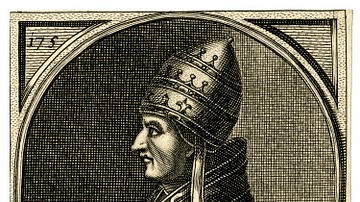
Pope Innocent III
Pope Innocent III (not to be confused with anti-pope Innocent III), r. 1198-1216 CE, is depicted in this print from Chronologia Summorum Romanorum Pontificum, published in 1675 CE. The text at the bottom reads "Innocent III...

Image
Two Statues of Shalmaneser III at the Iraq Museum
In the centre of this image is the so-called Kurba'il statue of Shalmaneser III (reigned 858-824 BCE), which was found in Fort Shalmaneser in 1961 CE by the British School of Archaeology in Iraq. The...
Image
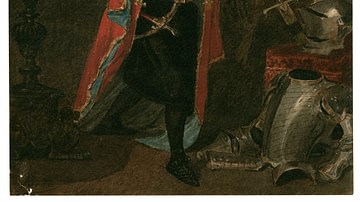
Richard III is Tormented by the Ghosts of His Victims - Richard III, Act V, Scene III
Richard III of England is tormented by the ghosts of his victims on the eve of his death at the Battle of Bosworth, in Act V Scene III of William Shakespeare's play The Tragedy...

Image
The Black Obelisk of Shalmaneser III, side A, 5th register
Tribute from Qarparunda the Patinean: silver, gold, tin, "fast" bronze, ivory (tusks), and ebony. Patina is modern Antakya, south of Turkey. From Nimrud, (ancient Kalhu), near the building...
Image
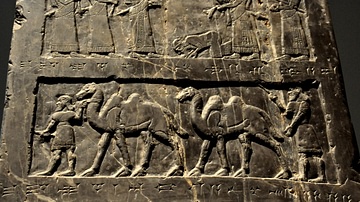
The Black Obelisk of Shalmaneser III, side A, 3rd register
Attendants bring tribute from Musri with two-humped camels. Musri, meaning a borderland, probably refers to a country in eastern Iran or in Egypt. From Nimrud, (ancient Kalhu), near the building...
Image
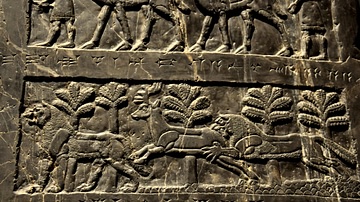
The Black Obelisk of Shalmaneser III, side A, 4th register
Lions and a stag from Marduk-apla-usur the Suhean, probably for the Royal hunting park. Suhi is an area on the middle Euphrates, between modern Syria and Iraq. From Nimrud, (ancient Kalhu), near...

Definition
Matilda of Tuscany
Matilda of Canossa (c. 1046-1115), the Countess of Tuscany (r. 1055-1115) and Vice-Queen of Italy (r. 1111-1115), was the final head of the noble House of Canossa following the deaths of her father in 1052 and her elder brother...

Definition
Zvartnots Cathedral
The ruins of Zvartnots Cathedral are located on a flat plain within the Ararat Plateau between the cities of Yerevan and Etchmiadzin in Armenia's Armavir province near Zvartnots International Airport. Built in the middle of...
Image
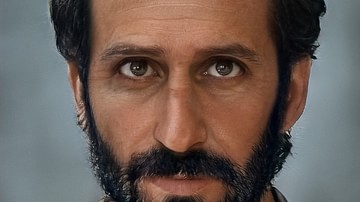
Darius III (Artistic Facial Reconstruction)
A photorealistic representation of the Persian king Darius III (r. 336-330 BCE) as he may have appeared. This reconstruction is largely based on artistic evidence like the Alexander Mosaic (c. 100 BCE) and...

Image
Demolition of the Monument to Alexander III in Moscow
Photograph of the demolition of the monument to Alexander III in Moscow, July 1918. As Tsarist Russia fell in 1917, so did the monuments of its monarchs. The colossal bronze statue to Alexander III...
