
Search
Remove Ads
Advertisement
Search Results
Image
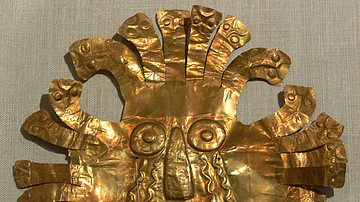
Nazca Gold Mask
A beaten gold mask from the Nazca civilization of Peru, 200 BCE-500 CE. 18.4 x 20.5 cm. The mask may represent a shaman in transformational pose, a common motif in Nazca art. An alternative interpretation is that it represents...
Image
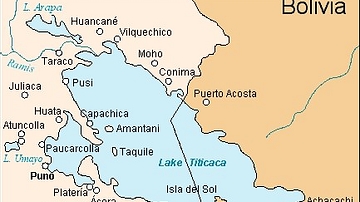
Lake Titicaca
A map of Lake Titicaca in South America, located between Peru and Bolivia. For ancient Andean peoples the lake was a sacred site and considered the centre of the cosmos and place of original creation.

Image
Nazca Line Spider
A geoglyph showing the Nazca Line Spider. The designs and lines created on the desert floor of southern Peru are known collectively as the 'Nazca Lines' and were made over several centuries between 200 BCE and 500 CE. Their exact...
Image
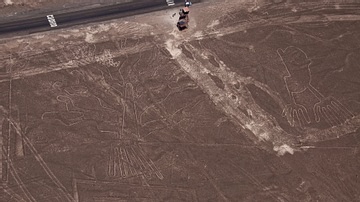
Nazca Line Cactus
A Nazca geoglyph depicting a cactus. The designs and lines created on the desert floor of southern Peru are known collectively as the 'Nazca Lines' and were made over several centuries between 200 BCE and 500 CE. Their exact...

Image
Paracas Mantel
Mantel (Detail), 100 BCE / 200 CE. Paracas; south coast, Peru. The Art Institute of Chicago, Emily Crane Chadbourne Fund.
Image
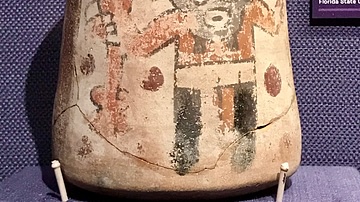
Nazca Skeleton Harvester Jar
This type of unusual pottery was made by the Nazca civilization that inhabited what is now present-day Peru. This piece features skeletal figures, and it was made c. 200 BCE-600 CE. (The Department of Anthropology and...

Image
Wari Vessel
This Wari (Huari) vessel from the Apogee Epoch (c. 1 CE - 800 CE) combines sculpture with color and has motifs outlined in black. Housed at Museo Larco, Lima, Peru.
Image
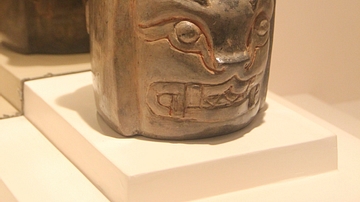
Cupisnique Anthropomorphic Feline
From the Formative Epoch (c. 1250 BCE - c. 1 CE). On Earth, the supreme leaders of this society assumed the power of the feline. The great religious, political, and economic power they accumulated enabled the development...
Image
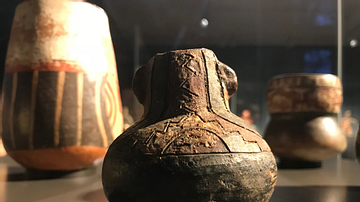
Paracas Ceremonial Vessel
This ceremonial vessel made of terracotta clay comes from what is present-day Peru and was made by the Paracas Culture between the 8th-3rd centuries CE. The Paracas Culture was the forerunner to the Nazca civilization.

Image
Signposts at the Tucume Museum
Signposting at the Tucume Museum, Peru. This photo was taken by Hilary Bradt and used with permission. Date unknown.
