
Search
Remove Ads
Advertisement
Search Results

Definition
Hatshepsut
Hatshepsut (r. 1479-1458 BCE) was the first female ruler of ancient Egypt to reign as a male with the full authority of pharaoh. Her name means "Foremost of Noble Women" or "She is First Among Noble Women". She began her reign as...

Definition
John Balliol
John Balliol ruled as the king of Scotland from 1292 to 1296 CE. He was supported by Edward I of England (r. 1272-1307 CE) in the competition to find the successor to the heirless Alexander III of Scotland (r. 1249-1286 CE), a process...

Article
Lost Civilisations of Anatolia: Göbekli Tepe
Göbekli Tepe is the world's oldest example of monumental architecture; a 'temple' built at the end of the last Ice Age, 12,000 years ago. It was discovered in 1995 CE when, just a short distance from the...

Definition
Macedon - Birthplace of Alexander the Great
Macedon was an ancient kingdom located in the north of the Greek peninsula first inhabited by the Mackednoi tribe whose identity was challenged by some southern Greeks but who, according to Herodotus (5:22...

Definition
Carolingian Dynasty
The Carolingian Dynasty (751-887) was a family of Frankish nobles who ruled Francia and its successor kingdoms in Western and Central Europe during the Early Middle Ages. The dynasty expanded from Francia as far as modern Italy...

Definition
God's Wife of Amun
The position of God's Wife of Amun was one of the most politically powerful and spiritually significant in later Egyptian history. Elevated from a figurehead in the New Kingdom (c.1570-1069 BCE), the God's Wife of Amun would...
Image
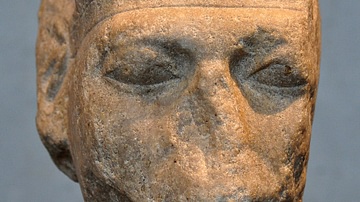
Pharaoh Senusret III
Quartzite head of the Egyptian pharaoh Senusret III (aka Sesostris III) with aged features. Middle Kingdom, 12th Dynasty, 1850 BCE. (State Museum of Egyptian Art, Munich, Germany).

Article
France’s 1905 Law of Separation of Church and State
The 1905 Law of Separation of Church and State was enacted as the climax of decades of conflict between monarchists and anticlerical Republicans who viewed Christianity as a permanent obstacle to the...

Article
Legions of Mesopotamia, Cappadocia, & Arabia
As the Roman Empire expanded further eastward, annexing territories that were once the domain of the Parthians, the legions of Mesopotamia, Cappadocia, and Arabia were called upon to safeguard these newly...

Image
Amenhotep III
From the mortuary temple of Amenhotep III, Thebes, Egypt 18th Dynasty, about 1350 BC Amenhotep III commissioned hundreds of sculptures for his mortuary temple on the west bank of the Nile at Thebes, though the precise original...
