
Search
Remove Ads
Advertisement
Search Results

Definition
Assyrian Warfare
Assyria began as a small trading community centered at the ancient city of Ashur and grew to become the greatest empire in the ancient world prior to the conquests of Alexander the Great and, after him, the Roman Empire. While...

Image
Richard III & Henry VII, Stained Glass Window
A stained glass window showing the two rivals for the throne of England at the end of the Wars of the Roses (1455-1487 CE). In 1485 CE at the Battle of Bosworth, Richard III of England (r. 1483-85 CE) was...
Image
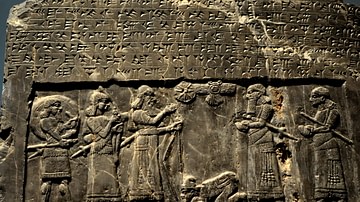
The Black Obelisk of Shalmaneser III, side A, upper register
The Assyrian king Shalmaneser III, holding a bow, receives a tribute from Sua the Gilzanean. The king faces his field marshal and another official.From Nimrud, (ancient Kalhu), near the building...

Image
Head of Senusret III
Granite head from a sphinx of the Egyptian pharaoh Senusret III with youthful features. Egypt. Middle Kingdom, 12th Dynasty, 1870 BCE. (State Museum of Egyptian Art, Munich, Germany).

Image
King Tiglath-pileser III
An alabaster bas-relief depicting the Assyrian king Tiglath-pileser III. From the central palace, Nimrud (ancient Kalhu), Mesopotamia, northern Iraq. Neo-Assyrian era, circa 728 BCE. (The British Museum, London)

Image
Alabaster Panel from the Central Palace of Tiglath Pileser III
This alabaster panel was part of the decorative scheme of the palace of King Tiglath Pileser III (reigned 745-727 BCE) at Kalhu. The king is shown in his chariot, while in another scene above...
Image
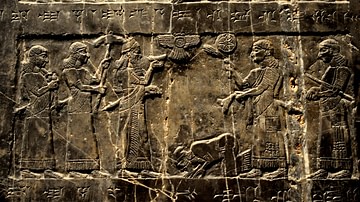
The Black Obelisk of Shalmaneser III, side A, 2nd register
The Assyrian king Shalmaneser III beneath a parasol, accepts the tribute from Iaua from the house of Humri in 841 BCE. This is king Jehu of Israel, who appears in the Bible (2 Kings 9-10). From...
Image
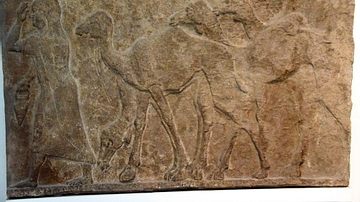
Captured Camels from Arab Enemies of Tiglath-pileser III
The woman on the left and the herd of camels behind her are part of a procession of prisoners and booty captured during one of the military campaigns of Tiglath-pileser III (reigned 744-727 BCE...

Image
Tiglath-pileser III, Submission of Enemy
An alabaster bas-relief depicting the Assyrian king Tiglath-pileser III stands over a captured enemy. The cuneiform inscription describes an Assyrian campaign in Iran 744 BCE. From the central palace at Nimrud...

Image
King Tiglath Pileser III Holds a Bow
Siege scene depicting the Assyrian king Tiglath Pileser III armed with a bow. Next to him, an Assyrian warrior wears a classical pointed Assyrian helmet and holds a dagger. Alabaster wall relief, from Nimrud (ancient...
