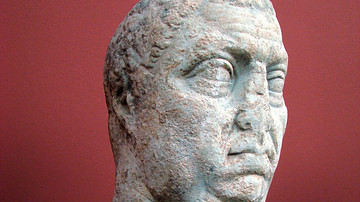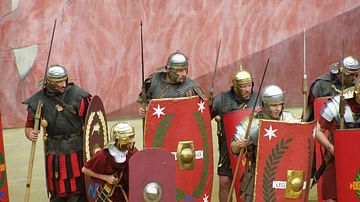


The Year of the Four Emperors (69 CE) was a brief period of political upheaval and civil war in the Roman Empire. In the aftermath of the death of Emperor Nero, four men – Galba, Otho, Vitellius, and Vespasian – were recognized as emperor in quick succession during a single year, three of them meeting gruesome and violent ends. It was the first civil war the empire had experienced since the dying days of the Roman Republic, shaking the foundations of the Pax Romana.
Background
In the middle of a warm June night in 68 CE, Emperor Nero jolted awake to find that he had been abandoned. Except for a handful of attendants, his palace was completely deserted; guards, servants, and advisors had all fled in the night. Nero got up and, after briefly contemplating suicide, decided to flee. Disguised in a cloak, he and four of his closest attendants – including Sporus, the slave boy he had recently castrated and married – fled to a villa four miles (6.4 km) away from Rome. There, Nero had his men dig him a grave while he paced back and forth, muttering to himself, "What an artist dies in me!" A short while later, he received a letter informing him that the Roman Senate had declared him a public enemy. Now, he had been abandoned by Rome itself. He was completely, utterly alone.
The trouble had started a few months back, when Gaius Julius Vindex, the governor of Gallia Lugdunensis, raised his banners in revolt. Like many others in the Roman elite, Vindex had come to despise Nero, whose egomania, vanity, and cruelty threatened to undermine the very foundations of the empire. But even as he was declaring his rebellion, Vindex knew he could not take on the might of the imperium by himself. He dispatched letters to his fellow governors asking for assistance.
The only man to show eager support was Servius Sulpicius Galba, governor of Hispania Tarraconensis (the largest Roman province in modern Spain). Since Vindex did not want the throne for himself, he offered to make Galba the figurehead of the rebellion. Though he was an old man with no familial ties to the imperial Julio-Claudian dynasty, Galba was well respected and came from a distinguished family, making him the best candidate around. In mid-April 68 CE, Galba was proclaimed emperor by his soldiers.
Galba spent the next several weeks preparing for war. He conscripted provincials from the lower orders into his army and issued edicts calling on all communities within his province to aid the insurrection. He attracted several prominent Romans to his banner, men who believed he was the better alternative to the tyrannical Nero. One of these was Marcus Salvius Otho, who had been Nero's friend until the emperor had stolen his wife and banished him to one of the empire's remotest provinces. As he watched his list of supporters grow, Galba must have felt confident.

But then, he received terrible news – Vindex had committed suicide after being defeated in battle by forces loyal to Nero. For a while, Galba despaired that all was lost. However, it was not long before the wheel of fortune turned once again. Only a few weeks later came the night when Nero found himself abandoned, branded a public enemy. With no other recourse, he had one of his attendants help him drive a dagger through his throat. The Senate wasted no time recognizing Galba as emperor. His gamble, it seemed, had paid off.
Galba
By January 69 CE, Galba had only been on the throne for a little over half a year. But his reputation for cruelty and greed, first cultivated in Hispania, had become widely known, and he was already nearly as unpopular as his predecessor. He had first shown signs of malice during his entry into Rome, when he had massacred thousands of Nero's soldiers near the Milvian Bridge. Then, he refused to pay any soldier or member of the Praetorian Guard who had fought against Vindex or who had failed to swear loyalty to him in time.
He confiscated property from Roman citizens and dismissed his Germanic bodyguard. But his worst offense, in the eyes of many Romans, was that he relied on the counsel of three men of villainous repute who had accompanied him from Hispania: Titus Vinius, Cornelius Laco, and a freedman named Icelus. According to the historian Tacitus, Vinius was said to have been "the vilest of men" while Laco was "the laziest" (1.6).
On 1 January 69 CE, the legions of Upper Germania refused to swear loyalty to Galba, instead toppling his statues and demanding that the Senate choose a new emperor. A few days later, the legions of Lower Germania followed suit and proclaimed their own general, Aulus Vitellius, as emperor. Galba was disturbed by this upheaval and knew that the best way to consolidate power and quell future unrest was to choose an heir, since he was old and childless.
The most obvious choice was Otho, who had been with him since the beginning of the rebellion, was still young and popular, and hailed from an illustrious family. But Galba knew that Otho had been close friends with Nero and shared many of the same personality traits. Unwilling to risk upsetting the people by adopting a second Nero, Galba instead chose Piso Licinianus as his heir. Piso was widely regarded as a good and noble man and seemed to be a wise choice. Tacitus writes that "there was an old-world austerity in his face and bearing, and just critics spoke of his strict morality" (1.14).
Otho was not one to take rejection well. He felt that he had been snubbed, that he had risked a lot when he joined Galba's rebellion, and that he deserved to be rewarded. He decided to take what was his and, together with disaffected soldiers and Praetorians, began conspiring to usurp the throne. On 15 January, Galba was sacrificing at the Temple of Apollo with Otho at his side. Suddenly, a freedman approached and whispered to Otho, "the architects are waiting" – the signal that the soldiers were ready to begin the coup.
Otho excused himself and made his way to the Roman Forum, where he was saluted by the soldiers and proclaimed emperor before being packed into a litter and shuffled off to the Praetorian camp. Word quickly spread that a coup was underway, and panic gripped the city. When Galba heard the news, he went to the palace and put on a linen cuirass, though he muttered that it would be little protection against so many swords. Eventually, he was informed that Otho had been killed. Believing the crisis had ended, Galba emerged onto the Forum. One of his last acts was to reprimand the soldier who claimed to have killed Otho, asking him on whose authority he had done so.

But Otho was not dead – this had merely been a ruse to lure the emperor out into the open. Galba and Piso were being carried through the streets on litters when they were approached by a group of Praetorians with their swords drawn. In the chaos that followed, Galba was unceremoniously dumped from his chair by his fleeing servants. He was defended by a lone Praetorian, Sempronius Densus, who held back his traitorous brothers-in-arms for a while.
According to the historian Plutarch, Sempronius had never been given any favor by Galba, but he defended the emperor all the same, making "a defense for a long time, until at last he was cut under the knees and brought to the ground" (Plutarch, Life of Galba). The assassins then converged on Galba, who stood, bared his throat, and dared them to "strike, if it serves the country's need" (Tacitus, 1.41). They did, stabbing him until his mangled and headless body was unrecognizable. Next, the Praetorians tracked down Piso, who had fled to the Temple of Vesta during Sempronius's last stand. They dragged him onto the sacred temple steps, where they proceeded to hack him to pieces.
Otho
Otho knew the deed was done when he was presented with Piso's head. He held it in his hands, contemplating it for a long time with "insatiable eyes" (Tacitus, 1.44). The new emperor finished the job by eliminating Galba's hated advisors – Vinius had been killed during the initial coup, Laco was exiled and later assassinated, while Icelus was publicly executed. After the Senate recognized Otho as emperor, many feared that his regime would resemble that of Nero.
Indeed, some of Otho's first decrees were to put the busts and statues of Nero back up, reinstate Nero's household officials, and dedicate 50,000 sesterces to the completion of Nero's vanity project, the Domus Aurea (Golden House). He was even hailed by the masses as ‘Nero Otho'. Yet Otho put some of his detractors at ease by showing clemency to his opponents, and by promising the Senate that he would be guided in his rule by the "broadest possible spread of public opinion" (Suetonius, Otho, 7).

But although Otho was able to charm and win over some of his enemies in Rome, he still had to contend with Vitellius and the mutinous German legions. Vitellius had about 70,000 soldiers under his command, including Roman legionaries and Batavian auxiliary troops, quite a formidable force. Already, the vanguard of Vitellius's army had crossed over the Alps and advanced into northern Italy. Otho dreaded the possibility of a civil war. Indeed, he shuddered whenever anyone brought up the fates of Marcus Junius Brutus and Gaius Cassius Longinus, the men who had assassinated Julius Caesar before paying the price with their lives at the Battle of Philippi 42 BCE.
Initially, Otho tried to negotiate with Vitellius, offering him his choice of luxury villas if he would only stand down. But when the negotiations failed, Otho knew he had no other choice but to fight. He left Rome on 14 March at the head of an army comprised of Roman legionaries, Praetorians, and even a force of gladiators. Many of his troops were veterans of the recent war in Roman Britain with the Iceni Queen Boudicca.
In early April, Otho won three minor skirmishes against Vitellius's men. Though this boosted his confidence, he knew the decisive engagement was yet to come. On 14 April, the two armies clashed at the First Battle of Bedriacum, near Cremona in northern Italy. The fighting was bloody and chaotic, and lasted all day. As Tacitus describes:
They fought now from a distance, now at close quarters, and charged sometimes in detachment, sometimes in column. On the raised high-road they fought hand to hand, using the weight of their bodies and their shields. They gave up throwing their javelins and cut through helmet and breastplate with sword and axe. Each man knew his foe; they were in view of the other troops, and they fought as if the whole issue of the war depended on them.
(2.42)
In the end, the center of Otho's line broke, and his men fled in panic. According to Cassius Dio, as many as 40,000 men were killed or wounded that day. Otho had not been present at the battle but remained at camp, eagerly waiting to hear the outcome. When he learned of his defeat, he knew that it was pointless to keep fighting and resolved instead to die. He made this decision partly out of concern for his soldiers, remarking, "I will no longer risk the lives of such men, who deserve so well" (Suetonius, Otho, 10). He spent the night putting his affairs in order and seeing to matters of state. Then, early on the morning of 16 April 69 CE, he ended his own life, driving a dagger into his chest with a single thrust. He had ruled for only 95 days.
Vitellius
After his victory at Bedriacum, Vitellius continued to Rome, where he was proclaimed emperor by the Senate. He entered the city "to a great blast of trumpets and with standards and banners massed all around him, wearing a general's cloak and a sword at his side" (Suetonius, Vitellius, 11). A lavish and gluttonous man, Vitellius's brief reign was one of excess and waste. According to Suetonius, he would have up to four banquets a day and would often serve his guests a dish so large it was known as the ‘Shield of Minerva'. It included such delicacies as parrotfish liver, peacock brains, flamingo tongues, and the entrails of lampreys sourced from Parthia and Spain.

He quickly drained the imperial treasury with extravagant gladiatorial games and expensive triumphal parades. Moreover, he was a cruel man who "delighted in putting people to torture or death, without regard for who they might be or what the justification" (Suetonius, Vitellius, 14). He not only executed political opponents but also moneylenders to whom he owed a debt. Reportedly, he also executed people who badmouthed his favorite chariot racing team, the Blues, viewing such talk as implicit criticism of his own regime.
But as Vitellius was busy establishing himself in Rome, a new threat was rising in the East. On 1 July, the Roman legions in Alexandria, Egypt, proclaimed Titus Flavius Vespasianus – Vespasian – emperor. A man of humble origins, Vespasian had risen through the ranks of Roman politics and achieved renown as a military commander. He had spent the last two years suppressing the Great Jewish Revolt of 66 CE in Judea and had been about to lay siege to Jerusalem when word reached him of Nero's death. Immediately, he had paused military operations to await instructions from the new government and sent his son, Titus, off to congratulate Emperor Galba.
However, Titus had only made it to Corinth when he learned of Galba's assassination. He returned to his father with the news, and, after a brief council, Vespasian decided to make his own bid for the throne. He spent the next several months readying his soldiers and gaining the support of powerful allies, like Gaius Licinius Mucianus, governor of Syria, and Tiberius Julius Alexander, prefect of Egypt. It was Alexander's troops who first declared for Vespasian.
Rather than head straight for Rome, Vespasian first went to Alexandria. Egypt was widely regarded as the breadbasket of Italy, and it was Vespasian's hope that, by shutting off the influx of grain to Rome, he could pressure the Senate into naming him emperor without an unnecessary effusion of bloodshed. But he soon became impatient and ordered Mucianus to go to Italy with three legions to meet Vitellius's forces in battle. Mucianus, however, had not even set foot on Italian soil when the legions of the Danube, sensing a chance for plunder and glory, mutinied and declared their allegiance to Vespasian.
Under the command of a rogue general named Marcus Antonius Primus, the Danubian legions invaded Italy. On 24 October, Primus's mutinous soldiers clashed with Vitellius's legions at the Second Battle of Bedriacum, near the exact site where Otho had met his end six months earlier. This time, it was Vitellius's troops who broke and fled. Primus's men celebrated their victory by burning and sacking Cremona for four days. Many of the residents were murdered or raped. For the first time since the fall of the republic, Roman soldiers killed Roman citizens.
In the aftermath of the battle, Rome was ablaze with panic. As news spread that Primus and the Danubian legions were quickly bearing down on the city, Vitellius desperately tried to retain his soldiers' loyalties by showering them with gifts and bribes. It was at this moment that Vespasian's brother, the urban praetor Titus Flavius Sabinus, tried to negotiate peace. He approached the emperor and urged him to abdicate in favor of Vespasian, an act that might save the city and, indeed, his own life.
While Vitellius seemed receptive to the idea, his soldiers were not. Outraged, they attacked Sabinus, ultimately forcing him to seek refuge on the Capitoline Hill with his children. Fighting raged on the hill and, amidst the chaos, the Temple of Capitoline Jupiter the Best and the Greatest burned down, an ill omen for the future of Rome. Eventually, Vitellius's vengeful soldiers captured Sabinus, who they brutally murdered.
Vespasian Triumphant
Cold December winds gripped Rome like a vise, as the Danubian legions crept closer. Growing increasingly desperate, Vitellius sent envoys out to negotiate with the rebels, each accompanied by a Vestal Virgin. But it was no use. On 20 December, Vitellius was informed that the enemy was at the gates of Rome. He disguised himself and prepared to flee, but when some of the Danube soldiers burst into the palace before he was ready, he hid in his room and barricaded the door with a bed and a mattress.
This was hardly an obstacle at all, and after the rebels broke in, they dragged the emperor from his room. They tied his hands behind his back, placed a noose around his neck, and stripped off much of his clothes. Then, they paraded the half-naked emperor into the Forum as the people threw jeers and filth at him. Finally, as Suetonius reports, Vitellius was "tortured to death by having his flesh delicately and methodically sliced from his body on the Gemonian Steps, from where his corpse was then dragged on a hook to the Tiber" (Vitellius, 17).

On 21 December, the Senate proclaimed Vespasian emperor – the fourth and final man to hold that office in the turbulent year of 69 CE. Mucianus entered Rome shortly thereafter and restored order, banishing the unpredictable Primus from the city, as well as his mutinous legionaries. He ruled in Vespasian's name for the next several months until October 70 CE, when the emperor himself arrived, welcomed by the Senate with grand fanfare. He would rule for the next decade and establish a new ruling house, the Flavian Dynasty. It was a new era, for neither Vespasian nor any of his three predecessors had any blood claim to the throne. From now on, it would not necessarily be bloodlines that made a Roman emperor, but swords.