
Search
Remove Ads
Advertisement
Search Results

Image
Alexander Severus
Portrait of Roman Emperor Alexander Severus (reign: 222 – 235 CE), from Ostia Antica. (Palazzo Massimo alle Terme, Rome)

Image
Aristides & Alexander I, 479 BCE
Alexander I the Philhellene visits the Greek camp, revealing Mardonius' battle plans to the Athenian general Aristides.
Source: M. A. Barth - 'Vorzeit und Gegenwart', Augsbourg, 1832 CE
Image
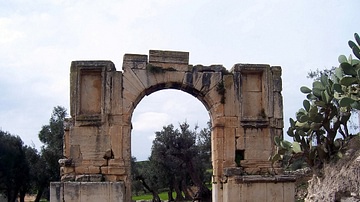
Arch of Alexander Severus, Dougga
The Arch of Alexander Severus is a Roman triumphal arch located in Dougga Tunisia (ancient Thugga). The arch was built in 228 CE, in gratitude to the emperor for his beneficence towards the city. It functioned as...

Image
Severus Alexander Bust, Milan
First half 3rd century CE, this marble bust depicts Emperor Severus Alexander (225-235 CE). Unknown provenance.
(Archaeological Museum, Milan)

Video
How Alexander Fleming Discovered Penicillin
Alexander Fleming was a Scottish doctor and microbiologist who discovered the world’s first effective antibiotic: penicillin. This discovery revolutionized medicine, and has been described as the single greatest...

Article
Warrior Women of the World of Ancient Macedon
The 8th November is celebrated as Archangels Day in Greece, but on that November day in 1977 CE something remarkable happened: an excavation team led by Professor Manolis Andronikos were roped down into...

Article
Practicing Magic in Greco-Roman World - Alexander of Abunoteichos & the Greek Magic Papyri
Magic was ever-present in the wider Greco-Roman world. Spells and herbs, spirits and gods, curses and blessings, prophecies and oracles, they were all the domain of the...

Image
Alexander the Great and Bucephalus
Alexander the Great on Bucephalus, bronze equestrian monument by Evangelos Moustakas, photograph by Franco R. Batista Garcia, Thessaloniki, 10 September 2025. Following the assassination of Philip II of Macedon...
Image
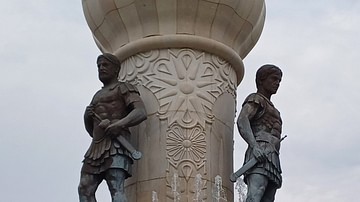
Colossal Statues of Philip II and Alexander III in Skopje
Colossal statues of Philip II of Macedon (r. 359-336 BCE) and Alexander the Great (r. 336-323 BCE) in Skopje. The Skopje 2014 (2010-2014) was a project involving the construction of 136 monumental...

Image
Alexander the Great
Marble head of Alexander the Great, found in the Kerameikos in Athens, c. 300 BCE. Alexander wears the lion’s pelt, a common iconographic feature in depictions of the young king on coins, which hints at his descent from the...
