
Search
Remove Ads
Advertisement
Search Results

Article
Passing of Philosophy to Religion: The Death of Hypatia
The death of the philosopher Hypatia of Alexandria (l. c. 370-415) has long been considered the "passage of philosophy to religion", exemplifying the transition from the pagan values of antiquity...
Definition
Indo-Greek
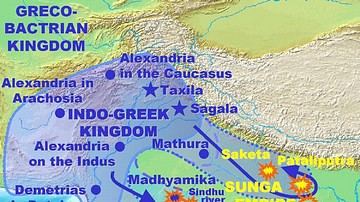
The first Indo-Greek kingdom appeared circa 190 BCE may when the Greco-Bactrian king or (general for his father) Demetrios was busy in India, when his Indian possessions were divided between several kings, probably firstly in order...

Article
Another Ariamanus Statue Found: The Evil Spirit of Mithraic Religion
It is rare when a new find creates renewed interest in an old subject. Here, the new find is a leontocephaline (lion-headed) figure of unknown provenance, weighing 5.8 kg and 37 cm in...

Definition
Greek Dark Age
The Greek Dark Age (c. 1200 to c. 800 BCE, overlapping with the Iron Age, c. 1200-550 BCE) is the modern-day term for the period in Greek history following the Bronze Age Collapse when the Mycenaean Civilization fell and the Linear...

Article
Religion & Superstition in Colonial America
Religion and superstition went hand in hand in Colonial America, and one’s belief in the first confirmed the validity of the second. The colonists' worldview was completely informed by religion and so everything...

Definition
Greek Mythology
Greek mythology was used as a means to explain the environment in which humankind lived, the natural phenomena they witnessed and the passing of time through the days, months, and seasons. Greek myths were also intricately connected...

Article
Greco-Bactrian and Indo-Greek Kingdoms in Ancient Texts
The rarity of the appearance of Greco-Bactrian and Indo-Greek kingdoms in ancient literature is one of the reasons why those states are so little-known today. Indo-Greek literature did exist, but...

Article
The Value of Family in Ancient Greek Literature
When looking at Ancient Greek literature, one can see the importance family plays in Greek culture. We see this displayed in the Greek works Medea by Euripides and Antigone by Sophocles. Throughout these...

Article
Religion in the Middle Ages
Religion in the Middle Ages, though dominated by the Catholic Church, was far more varied than only orthodox Christianity. In the Early Middle Ages (c. 476-1000), long-established pagan beliefs and practices entwined...

Article
Religion in the Mongol Empire
The Mongol Empire (1206-1368 CE) covered Asia from the Black Sea to the Korean peninsula and so naturally included all manner of religions within its borders, but the Mongols themselves had their own particular religious...
