
Search
Did you mean: Cronus?
Remove Ads
Advertisement
Search Results
Image
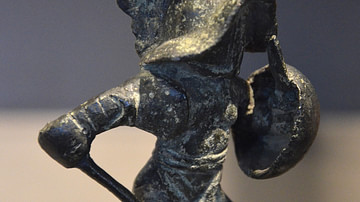
Bronze Statuette of a Hoplomachus
Bronze statuette of a hoplomachus, a type of gladiator in ancient Rome, armed to resemble a Greek hoplite (soldier with heavy armour and helmet, a round shield, a spear, and a sword). The hoplomachus wore a bronze...

Image
Bronze Age Burial Tomb at Lchashen
When Lake Sevan's water dropped due to hydroelectric production in 1950, countless graves and other ancient artifacts were uncovered in Lchashen, Armenia. Over the decades, 800 graves were discovered the majority...
Image
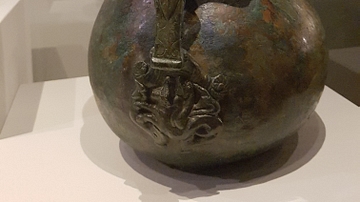
Bronze Pitcher From Pompeii
A bronze pitcher with Nereid (sea nymph). 1st century CE. Soprintendenza Archeologica di Pompei, (photo taken at the National Maritime Museum, Sydney Australia) Utensils for serving food were another way of showing...
Image
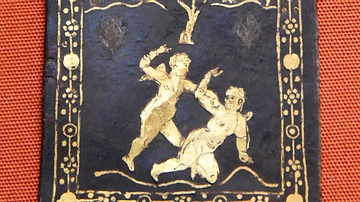
Bronze Plaque Showing Cupids Wrestling & Boxing
The background metal is bronze containing traces of a gold and silver, and its surface has been deliberately darkened, perhaps by organic acids. It may be an example of what Pliny calls "Corinthian bronze"...

Image
Bronze Head of Medusa
The bronze head of Medusa is a decorative element from one of the Nemi Ships built by Caligula around 37-41 CE. It is now in the Palazzo Massimo alle Terme in Rome.

Image
Bronze Greek Athlete
A bronze Greek athlete recovered from the sea off Marathon. 340-330 BCE. (National Archaeological Museum, Athens)

Image
Bronze & Gold Mycenaean Sword
A bronze Mycenaean sword with a gold handle inlaid with lapis lazuli, from Mycenae, Grave IV, Grave Circle A, 16th century BCE.
National Archaeological Museum, Athens.
Image
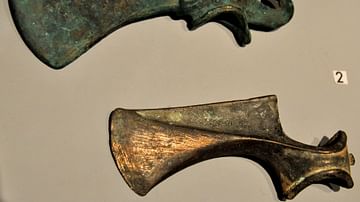
Bronze Shaft-Hole Axe
These two bronze shaft-hole axes date back to the late 3rd millennium BCE, Mesopotamia, Iraq. (The Sulaimaniya Museum, Iraq).

Image
Bronze Cat from Egypt
Hollow-cast bronze cat, probably a votive offering to the goddess Bastet, from Tell Basta, Egypt, c. 664-30 BCE.
National Museum of Scotland, Edinburgh.

Image
Bronze Bust of Juba II
A bronze bust of Juba II as a young man, created sometime in the 20s BCE. The bust was found in Volubilis, the western capital of Mauretania during the reign of Juba II. (Collection of the Rabat Archaeological Museum...
