
Search
Did you mean: Bes?
Remove Ads
Advertisement
Search Results

Image
Ancient India in 590 CE
This is a political map of India showing the important kingdoms that existed around 590 CE after the disintegration of the Gupta Empire (3rd century CE to 6th century CE). The main players appear to be the Chalukyas...

Image
11th century CE Kievan Rus Territories
Map of Kievan Rus territories during the feudal split, after the death of Prince Yaroslav the Wise in 1054 CE.

Image
Map of the Parthian (Arsacid) Empire, c. 150 CE - Iran’s Cavalry Empire Between Rome and the Silk Roads
The Parthian, or Arsacid, Empire (c. 247 BCE–224 CE) was an Iranian imperial state that emerged as Seleucid authority weakened in northeastern Iran. Arsaces...

Image
Map of Roman Rule in Asia Minor, c. 200 CE
This map illustrates the geopolitical landscape of Asia Minor during the reign of Emperor Septimius Severus (193–211 CE), around the year 200 CE. By this time, the peninsula (modern-day Turkey) had been under...

Image
England Around 910 CE
Map showing England around 910 CE, showing among others the Viking territories under the Danelaw as well as the English kingdoms of Mercia (at this point in time ruled by Aethelred, Lord of the Mercians (r. 881-911 CE) and...

Image
Umayyad Conquest, 7th & 8th Centuries CE
Map showing the Umayyad Arab (Islamic) expansion throughout the 7th and 8th centuries CE. In dark green is depicted the extent of Islam up until the death of Mohammed (622-632 CE); in the intermediate green...

Image
Map of the Empire of the Huns under Attila, c. 450 CE - Power, Pressure, and Collapse in Late Antiquity
The rise of the Huns in the 5th century CE reshaped the political landscape of Late Antiquity, culminating under Attila the Hun (reign 434-453 CE). Emerging...

Image
Map of New France, 1750 CE
A map of New France c. 1750 CE within the context of European colonies in North America.
Image
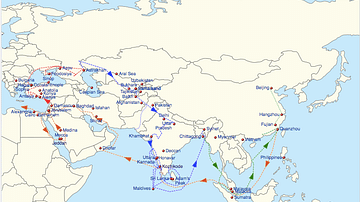
Map of Ibn Battuta's Travels, 1332-47 CE
A map showing the 1332-47 CE travels of Ibn Battuta (l. 1304-1368/69 CE) in Egypt. Battuta was a Moroccan explorer from Tangier whose expeditions took him further than any other known traveller of his time...

Image
Anglo-Saxon Clothing, 6-9th century CE
An illustration of the typical clothing worn by Anglo-Saxons in medieval England, c. 500 - c. 1000 CE. ('Costumes of all Nations', 1882 CE)
