
Search
Did you mean: Bes?
Remove Ads
Advertisement
Search Results

Image
Roman Province Bithynia et Pontus c. 200 CE
The Roman province of Bithynia et Pontus, established in 63 BCE after the defeat of Mithridates VI of Pontus, was a prosperous and strategically significant region by 200 CE. Located in northern Anatolia...

Image
Trade in the Roman Empire Map (c. 200 CE)
This map shows the major sources of trade goods in the Roman Empire, circa 200 CE. The map shows the sources of the following trade goods: grain, olive oil, slaves, wine, metals, textiles and wild animals.

Image
Map of the Middle East during the Second Fitna (c. 686 CE)
A map depicting the divisions of the Islamic Empire during the second Islamic civil war - the Second Fitna. The dominions of the Umayyads, Zubayrids, Kharjites, Al Mukhtar and those regained by...

Image
Khmer Empire c. 900 CE
A map illustrating in red the Khmer Empire c. 900 CE.

Image
Great Viking Army in England, 865-878 CE
Map showing the routes allegedly taken by the Great Viking Army that invaded the Anglo-Saxon Kingdoms in 865 CE, under leadership of such chieftains as 'Hingwar', 'Hubba', and 'Halfdene' (Anglo-Saxon Chronicle...

Image
Major Temples and Shrines of Japan circa 1200 CE, Kamakura Shogunate
This map depicts all major Buddhist temples and Shinto shrines of Japan around the year 1200 CE. Notice that many renowned temples (such as the famous Kinkaju-ji) have not yet been built...

Image
Knights in Armour, 15th century CE
Knights in armour typical of the 15th century CE. (Metropolitan Museum of Art, New York)
Image
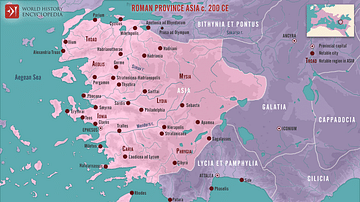
Roman Province Asia c. 200 CE
This map illustrates the Roman province of Asia around 200 CE. Established in 129 BCE following the bequest of the Attalid Kingdom of Pergamon to Rome, it encompassed western Anatolia (modern-day Turkey). It was a wealthy...
Image
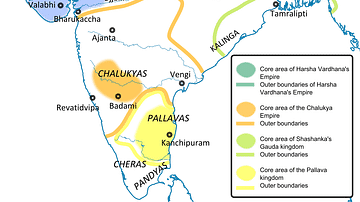
Ancient India in 625 CE
This is a political map of India showing the important kingdoms that existed around 625 CE. The predominant powers are the Pushyabhutis under Emperor Harshavardhana or Harsha (606-647 CE) in northern India, the (Vatapi...

Image
Paul the Apostle's First Missionary Journey (c. 46-48 CE)
Paul the Apostle undertook multiple missionary journeys across the Roman Empire to spread Christianity, establish churches, and strengthen the faith of early Christians. Paul's first missionary...
