
Search
Remove Ads
Advertisement
Search Results
Image
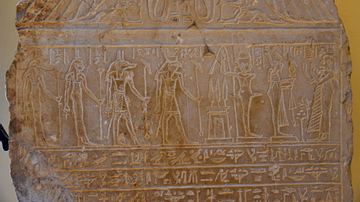
Funerary Stele Featuring Osiris, Min, Horus, Anubis, Isis, and Maat
This detail of a funerary stela depicts Takerseb (extreme right), a priestess of the goddess Min-Re, making an offering to the Egyptian gods and goddesses (from right to left: Osiris, Min...

Definition
Faravahar
The faravahar is the best-known symbol from ancient Persia of the winged sun disk with a seated male figure in the center. It is thought to represent Ahura Mazda, the god of Zoroastrianism, but has also been interpreted to signify...

Definition
Neith
Neith (aka Net, Neit or Nit) and is one of the oldest deities of ancient Egypt who was worshipped early in the Pre-Dynastic Period (c. 6000 - 3150 BCE) and whose veneration continued through the Ptolemaic Dynasty (323 - 30 BCE), the last...

Definition
Ancient Egyptian Literature
Ancient Egyptian literature comprises a wide array of narrative and poetic forms including inscriptions on tombs, stele, obelisks, and temples; myths, stories, and legends; religious writings; philosophical works; wisdom...

Definition
Astarte
Astarte is the Canaanite/Phoenician goddess of love, sex, war, and hunting who developed from the Mesopotamian deity Inanna/Ishtar. She is usually associated with the storm god Baal but seems to have been much more popular. She traveled...

Definition
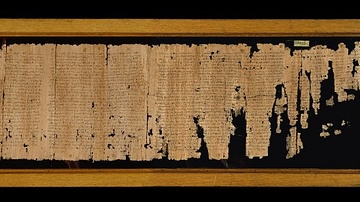
Book of the Heavenly Cow
The Book of the Heavenly Cow is an ancient Egyptian text dealing with the rebellion of humanity against the sun god Ra, his destruction of the rebels through the goddess Hathor, the reversal of this decision and Ra's mercy...
Article
The Tales of Prince Setna
Among the most engaging and influential works from Egyptian literature are the stories in the cycle known as Setna I and Setna II or The Tales of Prince Setna. These are fictional works from the Late Period of Ancient...

Definition
Djed
The djed is an ancient Egyptian symbol for stability which features prominently in Egyptian art and architecture throughout the country's history. `Stability' should be understood to mean not only a firm footing but immutability and permanance...

Article
Gods & Goddesses of Ancient Egypt - A Brief History
The land of ancient Egypt was alive with the spirit of the gods. The sun god Ra broke from the darkness every morning in his great boat, bringing the light, and many of the gods watched over the people...

Interview
Interview: Egyptian Mythology by Garry Shaw
World History Encyclopedia is joined by Egyptologist and author Garry Shaw to chat about his new book Egyptian Mythology: A Traveller's Guide from Aswan to Alexandria. Kelly (WHE): Do you want to start with...
