
Search
Remove Ads
Advertisement
Search Results

Definition
Dionysos
Dionysos (Roman name: Bacchus, also known as Dionysus) was the ancient Greek god of wine, merriment, and theatre. Being the bad boy of Mt. Olympus, Dionysus was perhaps the most colourful of the Olympian Gods. Son of Zeus In Greek...

Definition
Qilin (Chinese Unicorn)
The qilin (麒麟, or simply lin 麟) is a Chinese mythical creature, frequently translated as "Chinese unicorn." While this term may suggest a one-horned creature, the qilin is often depicted with two horns. However, like the...

Definition
Saturn
Saturn (Saturnus) was a Roman god with a similar history to Cronus from Greek mythology. Often depicted in art wielding a scythe he was considered an agricultural god, especially associated with seed-corn. The Saturnalia festival, named...

Definition
Aeschylus
Aeschylus (c. 525 - c. 456 BCE) was one of the great writers of Greek Tragedy in 5th century BCE Classical Athens. Known as 'the father of tragedy', the playwright wrote up to 90 plays, winning with half of them at the great Athenian...
Definition
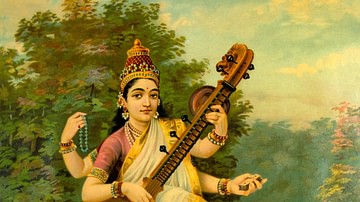
Saraswati
Saraswati (also Sarasvati) is the Hindu goddess of learning, wisdom, music, and aesthetics. She is also known as Bharati (eloquence), Shatarupa (existence), Vedamata ('mother of the Vedas'), Brahmi, Sarada, Vagisvari, and Putkari...

Definition
Cult of the Supreme Being
The Cult of the Supreme Being was a deistic cult established by Maximilien Robespierre (1758-1794) during the French Revolution (1789-1799). Its purpose was to replace Roman Catholicism as the state religion of France...

Definition
Kingdom of Saba
Saba (also given as Sheba) was a kingdom in southern Arabia (region of modern-day Yemen) which flourished between the 8th century BCE and 275 CE when it was conquered by the neighboring Himyarites. Although these are the most...

Definition
Apis
Apis was the most important and highly regarded bull deity of ancient Egypt. His original name in Egyptian was Api, Hapi, or Hep; Apis is the Greek name. He is not, however, associated with the god Hapi/Hep who was linked to the inundation...

Definition
Seshat
Seshat (also given as Sefkhet-Abwy and Seshet) is the Egyptian goddess of the written word. Her name literally means "female scribe" and she is regularly depicted as a woman wearing a leopard skin draped over her robe with a headdress...

Definition
God's Wife of Amun
The position of God's Wife of Amun was one of the most politically powerful and spiritually significant in later Egyptian history. Elevated from a figurehead in the New Kingdom (c.1570-1069 BCE), the God's Wife of Amun would...
