
Search
Remove Ads
Advertisement
Search Results

Image
Pottery Jar with Ankh Sign
A pottery jar with three painted representations of the ankh sign with 2 arms holding 2 was scepters. From the New Kingdom of Egypt, Ramesside Period, 1292-1069 BCE.
The British Museum, London.

Image
Pottery Cones
These bended pottery cones were probably used for votive purposes. Ubaid period, 4th millennium BCE, Mesopotamia, Iraq. (The Sulaimaniya Museum, Iraq).
Image
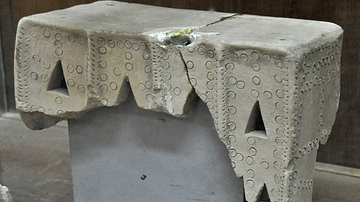
Pottery Thurible from Tell Basmosian
This is a fragment of a pottery thurible (censer for burning incense) which was found at Tell Basmosian (modern Lake Dukan, Sulaimaniya Governorate, Iraq). 2nd millennium BCE. (The Sulaimaniya Museum, Iraq).
Image
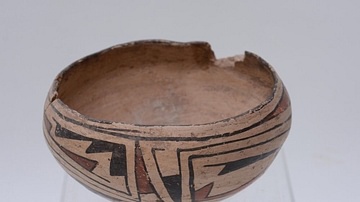
Pottery Bowl from Casas Grandes (Paquimé), Mexico
This pottery bowl comes from Casas Grandes (also known as "Paquimé"), which is located in what's present-day Chihuahua, Mexico. It is made from clay and dates to c. 1250-1400 CE. Casas Grandes was one...

Image
Mycenaean Pottery Vessels from Jordan
The term "Mycenaean" is derived from the site of Mycenae; it refers to the culture of Greece during the Middle and Late Bronze Ages. Mycenaean imports greatly increased around 1400 BCE and were mostly stirrup...
![Moche Head [Pottery Vessel]](https://www.worldhistory.org/img/c/p/360x202/9733.jpg?v=1599125404)
Image
Moche Head [Pottery Vessel]
Portrait head of a Moche man. Peru, Moche Culture, 1st to 7th century CE. Fired clay.
Exhibited at Museum Rietberg, Zurich, Switzerland.
Image
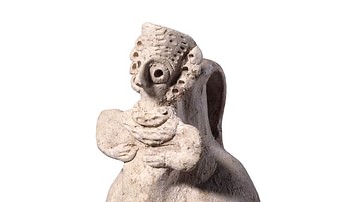
Amorite pottery juglet
Amorite, about 2400-2000 BC From the Middle Euphrates region, Syria This juglet, with its applied figurine, is pierced at the base and may have been a strainer. Alternatively it could have been used a sprinkler, by clamping...
Image
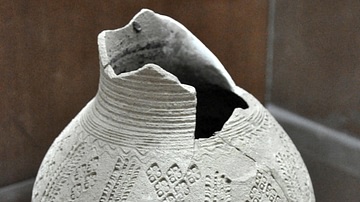
Pottery Jar from Hellenistic period
This partially broken jar dates back to the Hellenistic period, 323-30 BCE. From Mesopotamia, Iraq. (The Sulaimaniya Museum, Iraq).
Image
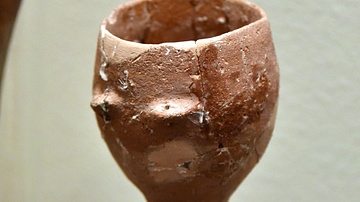
Pottery Goblet from Tulaylat al-Ghassul
Grape vines were first cultivated during the Chalcolithic period. It is probable that such goblets, which are similar to modern wine glasses, were used for drinking wine. Late Chalcolithic period, 3800-3600...

Image
Majiayao Chinese Pottery
This is a single-loop-handled pot from the Gansu Province of China; it dates back to the Majiayao Period, circa 3400 to 2000 BCE. Cyrus Tang Hall of China exhibit in the Field Museum in Chicago, Illinois, USA.
