
Search
Remove Ads
Advertisement
Search Results

Definition
Cylinder Seal - Ancient Personal Identification
Cylinder Seals were impression stamps used by the people of ancient Mesopotamia. Known as kishib in Sumerian and kunukku in Akkadian, the seals were used by everyone, from royals to slaves, as a means of...

Article
Legions of Mesopotamia, Cappadocia, & Arabia
As the Roman Empire expanded further eastward, annexing territories that were once the domain of the Parthians, the legions of Mesopotamia, Cappadocia, and Arabia were called upon to safeguard these newly...

Article
The Mesopotamian Pantheon - The Ancient Gods and Goddesses of the Near East
The gods of the Mesopotamian region were not uniform in name, power, provenance or status in the hierarchy. Mesopotamian culture varied from region to region and, because of this...

Article
Battle of the Wilderness - The Horrific Woodland Battle in the American Civil War
The Battle of the Wilderness (5-6 May 1864) was the opening engagement of the Overland Campaign, a major Union offensive conducted during the final year of the American Civil...
Article
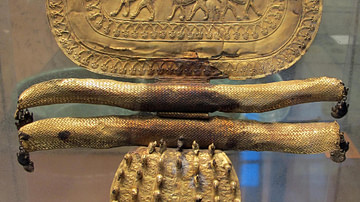
Regolini-Galassi Tomb
The Regolini-Galassi Tomb is located in the Etruscan town of Cerveteri (aka Cisra or Caere) near the western coast of central Italy, around 50 km north of Rome. Cerveteri flourished between the 7th and 4th century BCE and...
Article
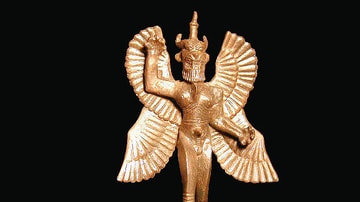
Twelve Menacing & Protective Mythological Figures
The term mythology comes from the Greek words mythos (“story of the people”) and logos (“word”) and so is defined as the spoken (later written) story of a culture. Modern scholars have divided myths...

Image
Achaemenid Silver Wine Pourer
This rhyton is one of the most famous pieces of silverware to survive the Persian Empire. The front is in the form of winged griffin wearing a necklace originally inlaid with a semi-precious stone. The top is decorated...

Image
Urartian Winged Demon
Ivory figure of a griffin-headed demon, from Altıntepe, an Urartian fortress and temple located in eastern Anatolia, 8-7th BCE.
Museum of Anatolian Civilisation, Ankara.
Image
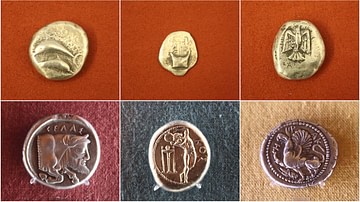
Ancient Greek Coins
Top row (L to R): Thera (c. 500 BCE) - Silver stater, two dolphins. Delos (6th century BCE) - Silver drachm, lyre. Siphnos (540-500 BCE) - Silver stater, eagle. (Alpha Bank Numismatics Museum, Kerkyra, Corfu) Bottom...
Image
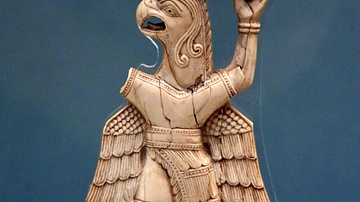
Urartian Ivory Demon
This is a griffin-headed demon of white ivory. Both arms are raised (the right is lost), probably to support a throne. From Toprakkale, Eastern Anatolia, in modern-day Turkey. Urartian, 8th to 7th century BCE. (The British...
