
Search
Did you mean: Hatti?
Remove Ads
Advertisement
Search Results

Image
Map of the Late Bronze Age Collapse and Transfromation - Interconnected political, economic & environmental breakdown
The Late Bronze Age Collapse and Transformation (c. 1250–1100 BCE) was a period of major political, economic, and social disruption across the Aegean...
Image
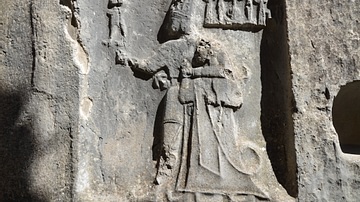
Hittite relief of the God Sharruma and King Tudhaliya
East wall of Chamber B of the Yazilikaya Hittite Rock Sanctuary near Hattusa (13th century BCE) depicting in a niche the God Sharruma (the Hurrian Mountain God and son of the Thunder God Teshub) embracing...
Image
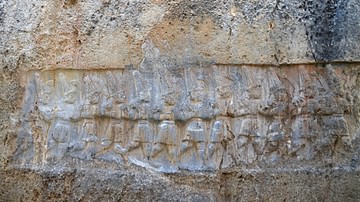
Twelve Gods of the Underworld, Yazilikaya Hittite Sanctuary
West wall of Chamber B of the Yazilikaya Hittite Sanctuary near Hattusa (13th century BCE) depicting the Twelve Gods of the Underworld. They wear short shirts, belts and shoes curling up at the...

Image
Treaty Establishing Hittite Domination over Aleppo
This clay tablet is known as the "Aleppo Treaty". The treaty was drawn up between the Hittite king Mursili II and Talmi-sharruma (king of Aleppo). It was written in Akkadian, the diplomatic language...
Image
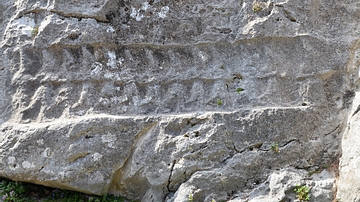
Rock Relief with Procession of Hittite Deities at Yazilikaya
Rock relief in Chamber A of the Yazilikaya Hittite Sanctuary (13th century BCE) near Hattusa depicting a procession of male deities. They all wear shoes curling up at the toe, and many are armed...
Image
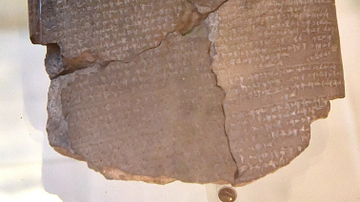
Plague Prayers of Mursilis II
The Hittite king Muršiliš II is imploring the gods to end the plague which has infested his country since the time of his father, Arnuwanda II. 13th century BCE (the tablet was originally written in the second half...
Image
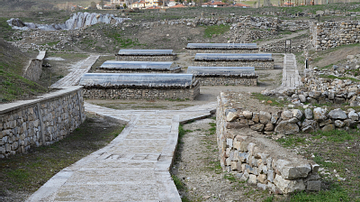
Hattian Royal Tombs at Alacahöyük
The Royal Tombs at Alacahöyük, built in the Early Bronze Age (2500-2000 BCE). Alacahöyük was the centre of the flourishing Hattian culture during the Bronze Age. It was later occupied by the Hittites who used the...
Image
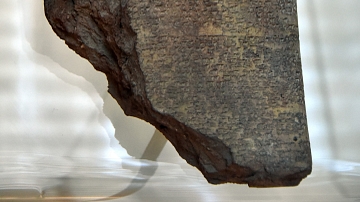
Hattusili III's Letter to Kadasman-Enlil II
This clay tablet represents a letter from Ḫattušili III (king of the Hittite Empire) to Kadašman-Enlil II (Kadashman-Enlil II; the Kassite king of Babylon). The beginning reads "I mourned for your father...

Image
Yazilikaya Hittite Rock Sanctuary
Yazılıkaya is a Hittite rock sanctuary located about 1.5 kilometres northeast of Hattusa, the capital city of the Hittite Empire in the late Bronze Age. It is the largest known Hittite rock monument. The sanctuary...
Image
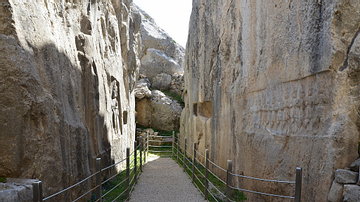
Yazilikaya Hittite Rock Sanctuary, Overview of Chamber B
The Yazilikaya Hittite sanctuary near Hattusa was made of two rock chambers, later labelled Chamber A and Chamber B by archaeologists. The walls of each chamber were covered with the richest and...
