
Search
Remove Ads
Advertisement
Search Results
Definition
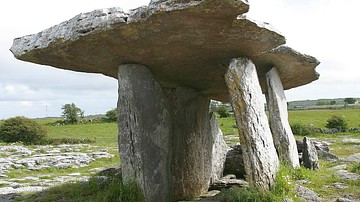
Dolmen
A dolmen is a megalithic structure typically formed from a large horizontal stone slab resting on two or more upright slabs. The oldest European examples are found in Brittany, northern France, and date to the 5th millennium BCE. Dolmens...
Image
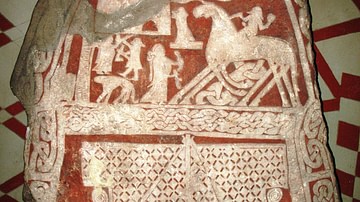
Odin on Sleipnir (Tjängvide image stone)
The Tjängvide image stone dating to the Viking Age found in Gotland, Sweden and probably showing Odin on his horse Sleipnir (or otherwise a dead man arriving at Odin's hall of Valhalla) on the middle-right.
Image
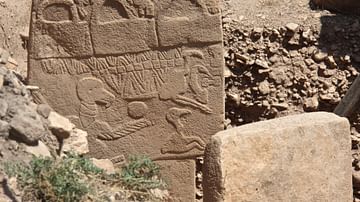
Vulture Stone, Göbekli Tepe
Göbekli Tepe is a c. 12,000-year-old archaeological site in Anatolia, Turkey. The deepest and oldest Layer III is also the most sophisticated with enclosures characterised by different thematic components and artistic...

Image
Olmec Colossal Stone Head, San Lorenzo
An Olmec colossal stone head in basalt from San Lorenzo, c. 1200-400 BCE. Although all wear the hat or headdress worn during war and the Mesoamerican ballgame, each of these massive heads has unique features...

Image
Altuna Rune Stone
The Altuna rune stone, showing the fishing trip of Thor when he fights the Midgard Serpent, Jörmungandr, Altuna, Uppland, Sweden.
Image
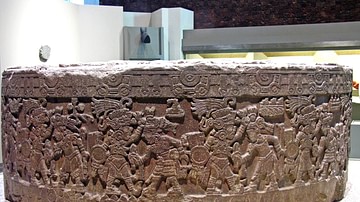
Tizoc Stone
The Tizoc Stone which depicts on its flat upper surface a sun-disk and around its edge a continuous frieze showing the Aztec king Tizoc and other warriors capturing deities of conquered peoples. 15th century CE. (National Museum of...

Image
Viking Rune Stone (Sanda, Sweden)
Top part of a rune stone found at Sanda, Gotland, Sweden, dating to the Viking Age, thought to depict Odin, Thor and Freyr. The runic inscription reads: 'Rodvisl and Farbjörn and Gunbjörn' (The Swedish History Museum/Historiska...

Image
Picture Stone with Sun Wheel
Picture stone with whirling suns, ornaments, and a ship, 5th-6th century.
Fornsalen Museum, Visby (Gotland).

Image
Stone Turtle, Karakorum
A stone turtle at Karakorum, Mongolia, from the khan's palace there. The city was made capital of the Mongol Empire in 1235 CE by Ogedei Khan (r. 1229-1242 CE).
Image
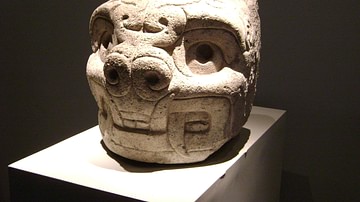
Chavin Stone Tenon Head
A stone head which originally protruded from the exterior wall of the temple at the Chavin religious site of Chavin de Huantar. Over 100 such heads have been found, each is unique and represents the transformation of a shaman...
