
Search
Remove Ads
Advertisement
Search Results

Definition
Maya Government
Ancient Maya government was formed on the basis that rulers were thought to have been god-like, which to some might suggest one unified state. However, the consensus amongst anthropologists supports that each major Maya city remained...
Image
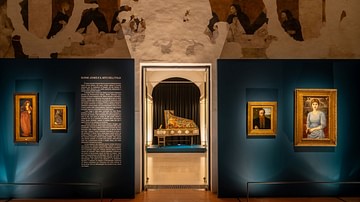
Pre-Raphaelites Exhibition
Pre-Raphaelites: Modern Renaissance, exhibition installation view, photo by Emanuele Rambaldi.
San Domenico Museum, Forlì, Italy.

Image
English Raid on Grand Pre, 1704
The English raid the Wabanaki settlement at Grand Pre in Acadia in 1704 during Queen Anne's War. By Hezekiah Butterwort, 1885.
Image
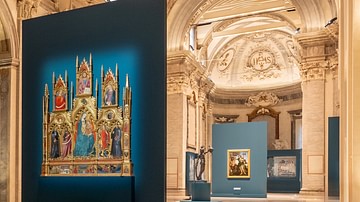
Pre-Raphaelites: Modern Renaissance in Forlì
Pre-Raphaelites: Modern Renaissance, exhibition installation view, photo by Emanuele Rambaldi.
San Domenico Museum, Forlì, Italy.
Image
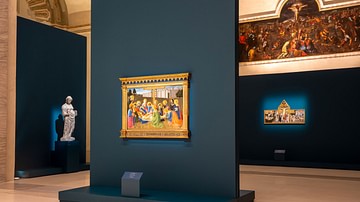
Pre-Raphaelites: Modern Renaissance Exhibition
Pre-Raphaelites: Modern Renaissance, exhibition installation view, photo by Emanuele Rambaldi.
San Domenico Museum, Forlì, Italy.

Definition
Heraclitus of Ephesus
Heraclitus of Ephesus (l. c. 500 BCE) was one of the early Pre-Socratic philosophers who, like the others, sought to identify the First Cause for the creation of the world. He rejected earlier theories such as air and water...

Definition
Greek Philosophy
Ancient Greek philosophy is a system of thought, first developed in the 6th century BCE, which was informed by a focus on the First Cause of observable phenomena. Prior to the development of this system by Thales of Miletus (l...

Definition
Anaxagoras
Anaxagoras (l. c. 500-c. 428 BCE) was a Pre-Socratic Greek philosopher who claimed the First Cause of existence was Mind (nous) and all things were constituted of indestructible “seeds” (or “stuff”), originally a single mass, separated...

Definition
Zeno of Elea
Zeno of Elea (l. c.465 BCE) was a Greek philosopher of the Eleatic School and a student of the elder philosopher Parmenides (l.c. 485 BCE) whose work influenced the philosophy of Socrates (l. c. 470/469-399 BCE). Zeno and Parmenides...

Image
The Columbian Exchange - Global Connections and Consequences after 1492
The Columbian Exchange (from 1492 CE) refers to the large-scale transfer of plants, animals, diseases, peoples, and technologies between the Americas and Afro-Eurasia following the transatlantic...
