
Search
Remove Ads
Advertisement
Search Results

Image Gallery
Relics from the Kingdom of Kush & Ancient Nubia
Kush was a kingdom in North Africa in the region corresponding to modern-day Sudan. The larger region around Kush (later referred to as Nubia) had been inhabited since c. 8,000 BCE, but the Kingdom of...

Article
A Brief History of Egyptian Art
Art is an essential aspect of any civilization. Once the basic human needs have been taken care of such as food, shelter, some form of community law, and a religious belief, cultures begin producing artwork, and often...

Definition
Old Dongola
Old Dongola (aka Dungulah or Dunkula), located in modern Sudan, was the capital of the ancient Nubian kingdom of Dongola (aka Makuria or Makurra) which flourished from the 6th to 14th century CE. A Christian kingdom for at least 750...
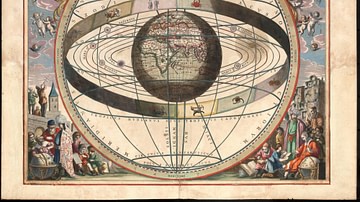
Image
Ptolemaic Universe
A 17th-century map by Jan van Loon of the cosmos as proposed by the astronomer and geographer Claudius Ptolemy (c. 100 - c. 170 CE).

Article
Great Female Rulers of Ancient Egypt
Women in ancient Egypt had more rights than in any other ancient culture and were valued with greater respect. This is evident not only in the physical evidence and inscriptions but in their religion. Some of the...

Image
Head of a Mummy from Ptolemaic-Roman Egypt
This is the upper part of the mummy of an unknown young man; probably, his age was below 21 years. The rest of the mummy is intact but is not shown here. The mummy was discovered in the 1820s. The elaborate...

Image
Book of the Dead, Ptolemaic Period
A detail from the Book of the Dead of Tayesnakht from Thebes, Ptolemaic Period, 332-30 BCE. (Egyptian Museum, Turin)
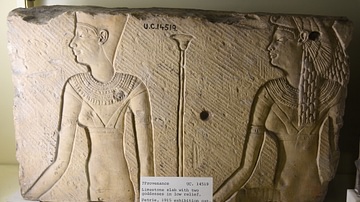
Image
Ptolemaic Slab with Two Goddesses
This is a limestone block which depicts the heads and bodies of two goddesses; both are looking to the left side. The background was left rough. From Egypt, precise provenance of excavation is unknown. Ptolemaic...
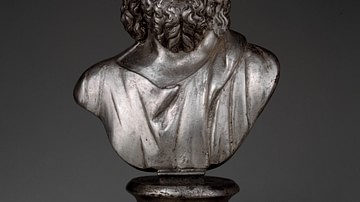
Definition
Serapis
Serapis is a Graeco-Egyptian god of the Ptolemaic Period (323-30 BCE) of Egypt developed by the monarch Ptolemy I Soter (r. 305-282 BCE) as part of his vision to unite his Egyptian and Greek subjects. Serapis’ cult later spread throughout...

Definition
Alexandria, Egypt
Alexandria is a port city on the Mediterranean Sea in northern Egypt founded in 331 BCE by Alexander the Great. It was the site of the Pharos (lighthouse), one of the seven wonders of the ancient world, and the legendary Library...
