
Search
Did you mean: Athens?
Remove Ads
Advertisement
Search Results
Article
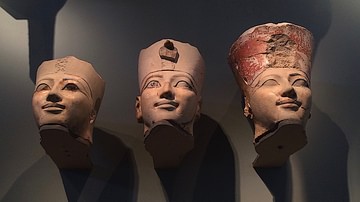
The Statuary of Maatkare Hatshepsut
One of the most fascinating aspects of the female pharaoh Maatkare Hatshepsut's reign (1479 - 1458 BCE) is the artwork she left behind. Art served an important purpose in Egyptian society; every statue, mural...

Definition
Indus Valley Civilization
The Indus Valley Civilization was a cultural and political entity which flourished in the northern region of the Indian subcontinent between c. 7000 - c. 600 BCE. Its modern name derives from its location in the valley...

Definition
Ancient Egypt - The Land of the Gods of Balance and Harmony
Egypt is a country in North Africa, on the Mediterranean Sea, and is home to one of the oldest civilizations on Earth. The name "Egypt" comes from the Greek Aegyptos, which was the Greek pronunciation...

Definition
Inca Civilization
The Inca civilization flourished in ancient Peru between c. 1400 and 1533 CE. The Inca Empire eventually extended across western South America from Quito in the north to Santiago in the south. It was the largest empire ever seen...

Definition
Maya Religion
Maya religious beliefs are formed on the notion that virtually everything in the world contains k'uh, or sacredness. K'uh and k'uhul, similar terms which are used to explain the spirituality of all inanimate and animate things...

Definition
Maya Government
Ancient Maya government was formed on the basis that rulers were thought to have been god-like, which to some might suggest one unified state. However, the consensus amongst anthropologists supports that each major Maya city remained...

Definition
Cleopatra VII - The Last Great Pharaoh of Ancient Egypt
Cleopatra VII (69-30 BCE, reign 51-30 BCE) was the last ruler of Egypt before it was annexed as a province of Rome. Arguably the most famous Egyptian queen, Cleopatra was ethnically Greek as a member...

Definition
Inca Government
The centre of Inca power was the capital Cuzco, considered the navel of the world. 40,000 Incas governed an empire of over 10 million subjects who spoke over 30 different languages. Consequently, the centralised government employed...

Definition
Ur - The Great Biblical City Abandoned by the Gods
Ur was a city in the region of Sumer, in southern Mesopotamia, and its ruins lie in what is modern-day Tell el-Muqayyar, Iraq. According to biblical tradition, the city is named after the man who founded...

Definition
Old Kingdom of Egypt - The Age of the Pyramids
The Old Kingdom of Egypt (circa 2613-2181 BCE) is also known as the "Age of the Pyramids" or "Age of the Pyramid Builders" as it includes the great 4th Dynasty when King Sneferu perfected the art of pyramid...
