
Search
Did you mean: Critias?
Remove Ads
Advertisement
Search Results

Definition
Arapaho
The Arapaho are a North American Native nation originally from the Red River Valley in modern-day Manitoba, Canada, and Minnesota, USA. They migrated south in the early 18th century and established themselves in modern-day Colorado...

Definition
Kykeon
Kykeon (from the Greek “to mix, stir”) was a beverage of water and barley (sometimes flavored with mint or thyme) popular among the working, 'lower' class of ancient Greece. In Homer's Illiad it is described as a mixture of water, barley...

Definition
Xunzi
Xunzi (pronounced shund-zee, l. c. 310-c. 235 BCE) was a Confucian philosopher of the Warring States Period (c. 481-221 BCE) in China. He is also known as Hun Kuang, Hsun Tzu, Xun Tzu, and Xun Kuang. Xunzi translates as Master Xun and...

Article
Origin of the Sweat Lodge
The sweat lodge is a temporary or permanent structure integral to Native American culture and frequently used in spiritual ceremonies. The lodge is often a low, dome-shaped, structure heated by hot rocks which produce...
Article
Early Judaism
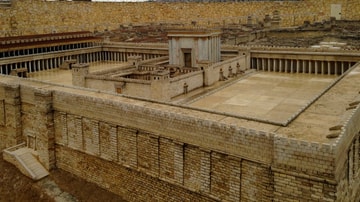
During the period of early Judaism (6th century BCE - 70 CE), Judean religion began to develop ideas which diverged significantly from 10th-to-7th-centuries BCE Israelite and Judean religion. In particular, this period marks a significant...

Article
Tibetan Sand Mandalas
Tibetan sand mandalas are works of art created to encourage healing, peace, and purification generally as well as spiritual or psychological focus specifically for those creating and viewing it. A mandala (Sanskrit for "circle"...

Interview
Rubin Museum's Faith and Empire: Tibetan Buddhist Art
Faith and Empire: Art and Politics in Tibetan Buddhism, a new exhibition at the Rubin Museum of Art in New York, explores the dynamic historical intersection of politics, religion, and art as reflected...

Article
Mandan Buffalo Dance
The Mandan Buffalo Dance is a ceremonial ritual observed in the modern era to honor the spirit of the buffalo and preserve Native American cultural traditions and was performed in the past for the same reasons just prior to...

Definition
Lao-Tzu
Lao-Tzu (l. c. 500 BCE, also known as Laozi or Lao-Tze) was a Chinese philosopher credited with founding the philosophical system of Taoism. He is best known as the author of the Laozi (later retitled the Tao-Te-Ching translated as “The...

Definition
Mo Ti
Mo Ti (l. 470-391 BCE, also known as Mot Tzu, Mozi, and Micius) was a Chinese philosopher of the Warring States Period (c. 481-221 BCE) associated with the Hundred Schools of Thought (different philosophical schools which established...
