
Search
Remove Ads
Advertisement
Search Results

Image
Minoan Royal Villa at Knossos
The Royal Villa is located northeast of the Palace of Knossos (Crete). It was built on the east slope of the hill of Knossos and consisted of a ground floor and two other floors which survive in relatively good condition...

Image
Elizabethan Royal Navy
A 1907 CE painting showing ships of the English Royal Navy during the Elizabethan period (1558-1603 CE).

Image
The Royal Observatory Greenwich
A print showing the Royal Observatory in Greenwich near London, founded in 1675. Engraving by Francis Place after Robert Thacker c. 1678. (British Library, London)

Image
Alabaster Relief of an Assyrian Royal Attendant
Alabaster work relief of an Assyrian royal attendant, from the northwest palace of Ashurnasirpal II. Reign of Ashurnasirpal II, 883-859 BCE, Nimrud (ancient Kalhu), Mesopotamia. (The Burrell Collection...
Image
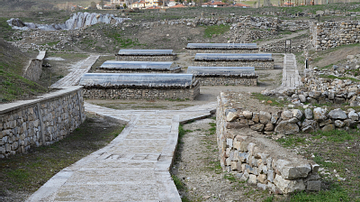
Hattian Royal Tombs at Alacahöyük
The Royal Tombs at Alacahöyük, built in the Early Bronze Age (2500-2000 BCE). Alacahöyük was the centre of the flourishing Hattian culture during the Bronze Age. It was later occupied by the Hittites who used the...
Image
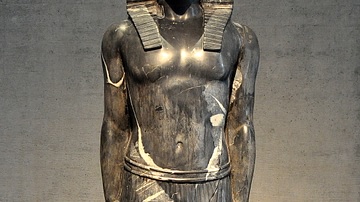
Egyptianized Royal Statue from Hadrian's Villa
This marble statue depicts a standing-striding royal man with an Egyptianized style and was found at Hadrian's villa (Tivoli), Italy. Roman period, circa 135 CE.(State Museum of Egyptian Art, Munich, Germany...
Image
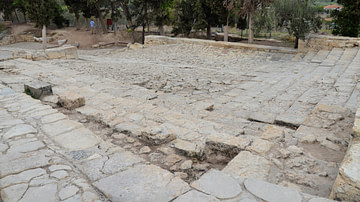
Theatral Area & Royal Road of the Palace of Knossos
View of the Theatral Area of the Palace of Knossos (Crete) and the Royal Road right below.
Image
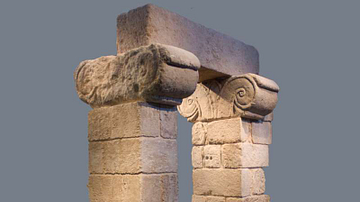
Royal Fortress Gate, Hazor
This object is an ancient Israelite royal fortress gate, made out of limestone. It was excavated from Hazor and dates to the Iron Age II (9th BCE). (The Israel Museum, Jerusalem) ©The Israel Museum, Jerusalem. Used with...

Image
Royal Lodge, Chateau d'Amboise
The 15th century CE Royal Lodge of the Chateau d'Amboise, Amboise, France.
Image
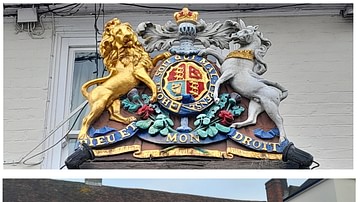
Royal Arms and the Dog & Bear, Lenham
The Dog & Bear in Lenham, Kent, England. The pub, built in 1602, was visited in 1704 by Anne, Queen of Great Britain (r. 1702-14) and so the queen's coat of arms was placed above the doorway to advertise this...
