
Search
Remove Ads
Advertisement
Search Results

Definition
Avesta
The Avesta is the scripture of Zoroastrianism which developed from an oral tradition founded by the prophet Zoroaster (Zarathustra, Zartosht) sometime between c. 1500-1000 BCE. The title is generally accepted as meaning “praise”, though...

Definition
Zarathustra
Zarathustra (also given as Zoroaster, Zartosht, Zarathustra Spitama, l. c. 1500-1000 BCE) was the Persian priest-turned-prophet who founded the religion of Zoroastrianism (also given as Mazdayasna “devotion to Mazda”), the first monotheistic...

Definition
Moses
Moses (c. 1400 BCE) is considered one of the most important religious leaders in world history. He is claimed by the religions of Judaism, Christianity, Islam, and Bahai as an important prophet of God and the founder of monotheistic belief...

Definition
Margery Kempe
Margery Kempe (l. c. 1373 - c. 1438 CE) was a medieval mystic and author of the first autobiography in English, The Book of Margery Kempe, which relates her spiritual journey from wife and mother in Bishop's Lynn, England to a chaste...
Definition
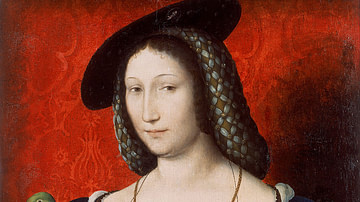
Marguerite de Navarre
Marguerite de Navarre (l. 1492-1549) was a writer, philosopher, diplomat, and Queen of Navarre, sister of King Francois I (Francis I of France, r. 1515-1547), mother of Jeanne d’Albret (l. 1528-1572) and grandmother of Henry...

Definition
Marie Dentière
Marie Dentière (l. c. 1495-1561) was a French theologian, writer, and street preacher who advanced the cause of the Protestant Reformation in Geneva, Switzerland. Her written works were controversial primarily because she was a...

Definition
Protestant Reformation
The Protestant Reformation (1517-1648) refers to the widespread religious, cultural, and social upheaval of 16th-century Europe that broke the hold of the medieval Church, allowing for the development of personal interpretations...

Definition
Augsburg Confession
The Augsburg Confession is the affirmation of faith of the Lutheran Church written by Philip Melanchthon (l. 1497-1560) and presented at the Diet of Augsburg in June 1530. The document attempted to reconcile differences between...

Article
Luther's 97 Theses
Martin Luther's 95 Theses, credited with sparking the Protestant Reformation in Europe, have become a cultural touchstone since he posted them 31 October 1517, but the little-known 97 Theses, posted only a month earlier, are...
Article
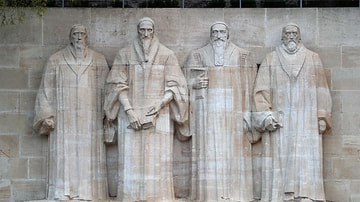
Ten Protestant Reformation Facts You Need to Know
The Protestant Reformation (1517-1648) was one of the most significant cultural, political, and religious events in the history of Europe and helped shape the modern world. It was a complex event spanning...
