
Search
Did you mean: Oshun?
Remove Ads
Advertisement
Search Results

Article
Greco-Bactrian and Indo-Greek Kingdoms in Ancient Texts
The rarity of the appearance of Greco-Bactrian and Indo-Greek kingdoms in ancient literature is one of the reasons why those states are so little-known today. Indo-Greek literature did exist, but...

Article
Hegra and Jabal Ikmah, AlUla, Saudia Arabia - Two different but stunning archaeological sites on the ancient incense trail
Although 30,000 archaeological sites have been identified in the AlUla area of Saudi Arabia, only 8 are currently open to visitors: Jabal Ikmah...

Article
A Praise Poem of Lipit-Estar - A Popular Sumerian Song
A Praise Poem of Lipit-Estar is a Sumerian praise song honoring Lipit-Estar (also known as Lipit-Ishtar, reign circa 1935 to circa 1924 BCE), the fifth king of the First Dynasty of Isin, best known...

Article
Shulgi and Ninlil's Barge - A Poem Celebrating a Divine Event
Shulgi and Ninlil's Barge is a Sumerian poem dated to the reign of Shulgi of Ur (2094 - circa 2046 BCE) celebrating the caulking of the barge of the goddess Ninlil, consort of the sky god Enlil...
Image
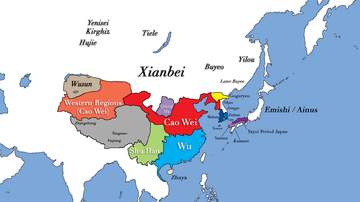
Three Kingdoms Period of China and the Rise of Xianbei in the year 229 CE
This map depicts the boundaries of all major civilizations in East Asia at the beginning of the Three Kingdoms Period of China, with italics indicating nomadic bands and other tribal...

Image
Mesopotamian Foundation Figurines
Certain types of figurines were commonly placed within foundations of buildings during the third dynasty of Ur (2100-2000 BCE) of the Neo-Sumerian Period, to commemorate the building of temples by the ruler. These...
Image
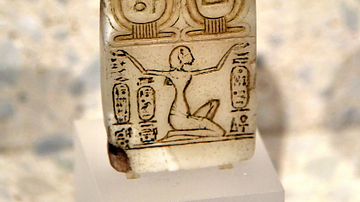
Early Cartouche of the God Aten
Early cartouche of the god Aten, calcite alabaster. New Kingdom of Egypt, 18th Dynasty, 1351-1334 BCE. At the upper part of this votive plaque of the God Aten, there are two "early" cartouches of Aten. On the right...
Image
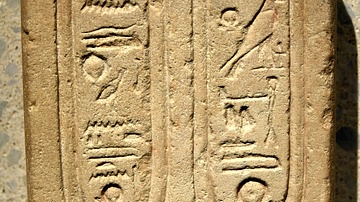
Early Cartouches of Aten
Limestone "early" cartouches of the god Aten. The one on the right reads "The living Re-Horakhty, Rejoicing in the horizon" while that on the left reads "In his name as Shu, who is in the Aten". From small houses, N 49.06...
Image
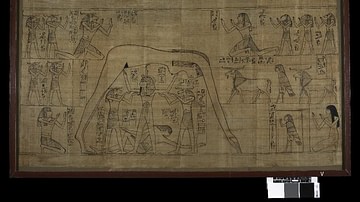
The Greenfield Papyrus
Book of the Dead of Nestanebtasheru (sheet 87): Geb is shown as a semi-recumbent figure stretching out his limbs while the elongated body of Nut arches above him. Her feet touch the ground at the eastern horizon and her fingers...

Video
Courtly Love in the High Middle Ages
Courtly Love is a literary genre of poetry that began in the south of France in the 12th century during the period known as the High Middle Ages. In this new genre of poetry, motifs were established that are still...
