
Search
Did you mean: Epona?
Remove Ads
Advertisement
Search Results

Article
Olmec Colossal Stone Heads
The stone head sculptures of the Olmec civilization of the Gulf Coast of Mexico (1200 BCE - 400 BCE) are amongst the most mysterious and debated artefacts from the ancient world. The most agreed upon theory is that, because...

Video
The Sun Stone (The Calendar Stone), Aztec
The Sun Stone (or The Calendar Stone), Aztec, reign of Moctezuma II (1502-20), discovered in 1790 at the southeastern edge of the Plaza Mayor (Zocalo) in Mexico City, stone (unfinished), 358 cm diameter...

Image
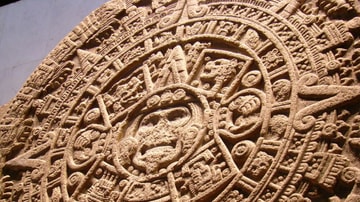
Aztec Sun Stone
The Aztec Sun Stone (also known as the Calendar Stone) is a representation of the five eras of the sun from Aztec mythology. The stone was part of the architectural complex of the Temple Mayor of Tenochtitlán and dates to c. 1427...
Image
Tonatiuh, Calendar Stone
The Aztec Sun Stone (also known as the Calendar Stone) is a representation of the five eras of the sun from Aztec mythology. Some scholars consider the central face to be that of Tonatiuh, the sun god, while others maintain...

Image
Aztec Sun Stone, 1792 Illustration
Aztec Sun Stone, illustration in Antonio León y Gama's Historical and Chronological Description of the Two Stones Which Were Found in 1790 During the Repaving of the Main Plaza in Mexico, 1792. Antonio León y...

Image
Moabite Stone
The Moabite Stone, an ancient tablet dating to around 850 BCE, written by Mesha, the king of Moab (modern Jordan). (Louvre Museum, Paris)
Image
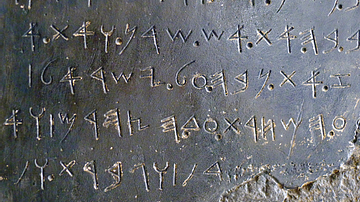
Detail, Moabite Stone
A detail of the Moabite Stone, an ancient tablet dating to around 850 BCE, written by Mesha, the king of Moab (modern Jordan). (Louvre Museum, Paris)
Image
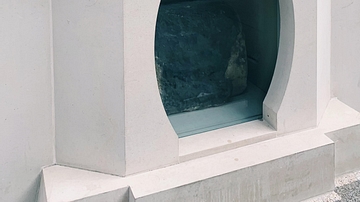
London Stone
On Cannon Street in the City of London, you can watch the London Stone. The stone's origin is unknown, but its importance as a landmark throughout London’s long history is almost incomparable, especially when thinking about the simplicity...

Image
Rosetta Stone
The Rosetta Stone is an incomplete grey and pink granodiorite stela dating from 196 BCE which presents a priestly decree concerning King Ptolemy V of Egypt. The text is in three different versions: Hieroglyphic, Demotic and Greek...
Image
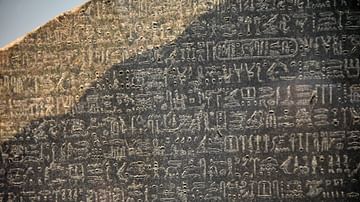
Rosetta Stone Detail, Hieroglyphic Text
This is a zoomed-in detail of the upper part of the Rosetta stone showing the hieroglyphic inscription. The Rosetta Stone is a large, mostly complete fragment of a grey-pink granodiorite stela. A decree was...
