
Search
Remove Ads
Advertisement
Search Results
Image
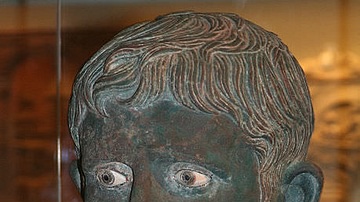
The Meroe Head of Augustus Caesar
The Meroe Head is from a larger-than life statue of Augustus Caesar (reigned 31 BCE-14 CE). It is 47.7 cm, made of bronze with alabaster, glass and coral inlays for the eyes. Discovered at Meroe in 1910 by J. Garstang...
Image
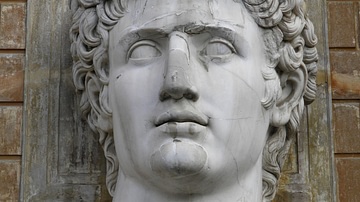
Colossal portrait of Augustus
Colossal portrait of Augustus, 1st century CE. (Vatican Museums, Rome)

Image
Denarius of Augustus with Crocodile
A Roman silver denarius coin depicting a crocodile and the legend AEGVPTO CAPTA. Reign of Augustus commemorating his victory in Egypt, 28-6 BCE. (Archaeological Museum, Tarragona, Spain)
Image
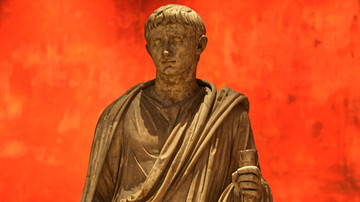
Statue of Emperor Augustus
Statue of Emperor Augustus (r. 27 BCE to 14 CE).
Ny Carlsberg Glyptotek, Copenhagen.

Image
Egyptianized Statue of Augustus
Granodiorite statue which depicts the upper part of a body of an Egyptianized king. The man is probably Roman emperor Augustus. From modern-day Egypt. Roman period, 1st century CE. (State Museum of Egyptian Art, Munich...
Image
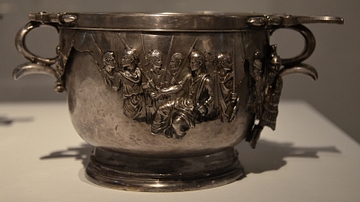
Skyphos Boscoreale with Augustus
Skyphos (two-handled wine cup) from the Boscoreale Treasure depicting Augustus receiving the obeisance of vanquished Barbarians and personifications of subdued provinces. Late 1st century BCE - early 1st century CE...
![Mausoleum of Augustus [Rear View]](https://www.worldhistory.org/img/c/p/360x202/4477.jpg?v=1618582532)
Image
Mausoleum of Augustus [Rear View]
The ruins of the Mausoleum of Augustus, Rome. Completed in 28 BCE, it was the largest tomb ever constructed in the Roman world.
Image
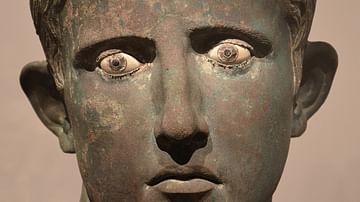
Bronze Head of Augustus
Bronze head from an over-life-sized statue of Augustus, found in the ancient Nubian site of Meroë in Sudan, 27 - 25 BCE. On display in the British Museum, London.
Image
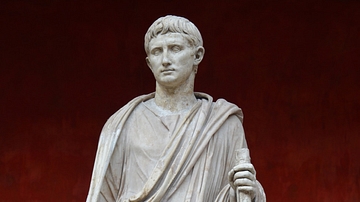
Statue of Augustus
A statue of Augustus depicted as magistrate. (Ny Carlsberg Glyptotek, Copenhagen)
Image
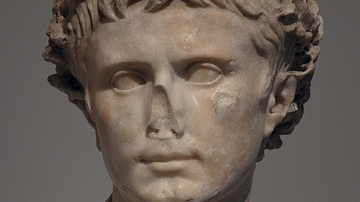
Bust of Augustus
Bust of Augustus wearing the oak crown (corona civica) discovered on the site of the Roman villa of Chiragan (France), 19-18 BCE. (Toulouse, Musée Saint-Raymond)
