
Search
Did you mean: Trajan's Column?
Remove Ads
Advertisement
Search Results

Image
Column of Marcus Aurelius
The Column of Marcus Aurelius and Faustina in Piazza Colonna, Rome. The column was erected in c. 180 CE and depicts in relief sculpture the emperor's campaigns across the Danube between 172 and 175 CE.

Video
Trajan's Forum
Apollodorus of Damascus, The Forum of Trajan, dedicated 112 C.E., Rome
A conversation with Dr. Beth Harris and Dr. Steven Zucker
Image
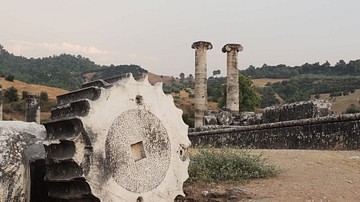
Column Drum with Flutes
A column drum with 24 flutes from the temple of Artemis, Sardis.
Image
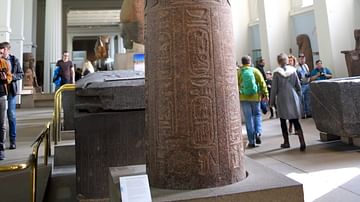
Palm-leaf Column of Ramesses II from Herakleopolis
This column is from a temple primarily dedicated to he dam god Heryshef of Herakleopolis. Ramesses II is twice shown making offerings to a local form of Osiris. The god wears his typical feather crown...
Image
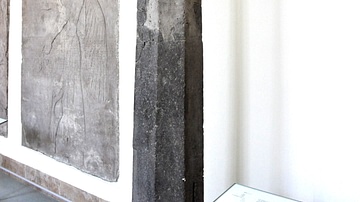
Basalt Column from Ashur
A number of basalt columns and their fragments were uncovered during archaeological excavations at the "Row of Stelae" at the city of Ashur. These were brought to the city as part of an important booty. The cuneiform inscriptions...
Image
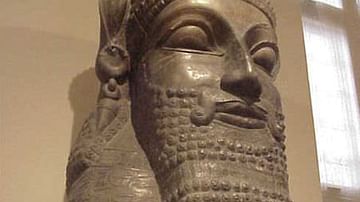
Column Capital, Persepolis
A column capital in the form of a bull-man from the Tripylon, Persepolis, Achaemenid Period, Reign of Xerxes 486-465 BCE. (The Oriental Institute, University of Chicago)

Image
Column Flutes, Parthenon
A drum from a column of the Parthenon, Athens showing the flutes of the shaft in cross-section.
Image
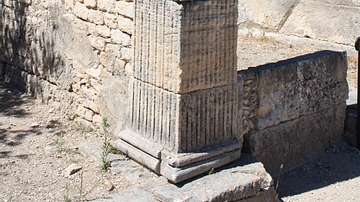
Square Column, Greek-Style House, Glanum
An unuusual square column from the peristyle of a Greek-style house at Glanum, southern France. 2nd-1st century BCE.
Image
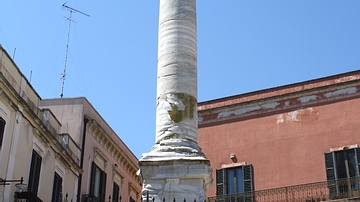
End of the Appian Way Column Marker
A 19.2 m marble column which dates to the 1st century BCE and was part of an honorary monument in Brindisum. Traditionally, the column was thought to mark the end of the Roman road the via Appia (Appian Way) but...
Image
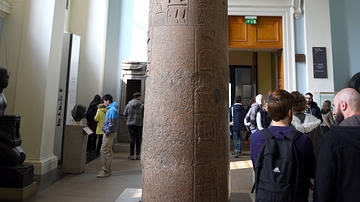
Palm-Leaf Column of Ramesses II, Pi-Ramesses
Palm-leaf column from Bubastis (Tell Basta), Temple of Baset; originally from Pi-Ramesses (Qantir), Egypt, 19th Dynasty, reign of Ramesses II (1279-1213 BCE) and 22nd Dynasty, reign of Osorkon II (874-850...
