
Search
Remove Ads
Advertisement
Search Results
Image
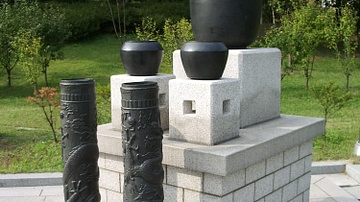
Sejong-era Water Clock Replica
Replica of a water-powered clock invented in 1433 CE by the royal scholars under the guidance of King Sejong the Great (r. 1418-1450 CE).
Yeouido Park, Seoul, South Korea.

Image
Cold Water Pool, Roman Baths at Milreu, Portugal
Cold water pool in the frigidarium (cold room) of the Roman baths at the villa at Milreu, southern Portugal. The interior of the pool is decorated with mosaics depicting fish and mussels. 4th century...
Image
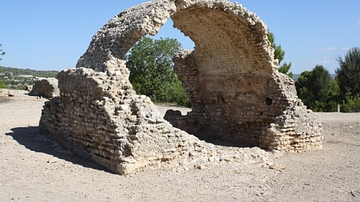
Roman Water Reservoir
The remains of a large water reservoir at the Villa of Els Munts, Tarraco. 1st century CE. (Tarragona, Spain).
Image
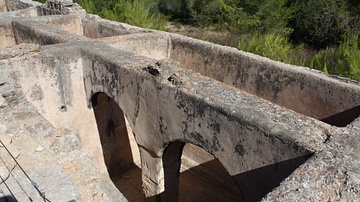
Roman Water Reservoir
A large water reservoir from the Roman Villa of Els Munts, Tarraco (Tarragona, Spain). 1st century CE.
Image
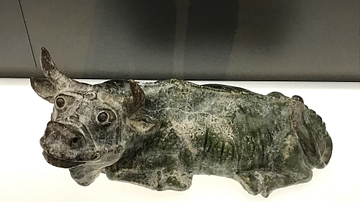
Ancient Chinese Water Buffalo Figure
This figurine of a reclining water buffalo comes from northern China. It was created during the period of the Eastern Han Dynasty, c. 2nd-3rd centuries CE. (Museum Rietberg, Zürich).
Image
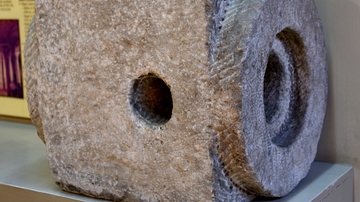
Water Conduit from Beyazit
This is a marble intersection water conduit. From Beyazit, modern-day Istanbul, Turkey. Fourth century CE. (Museum of Archaeology, Istanbul, Turkey).
Image
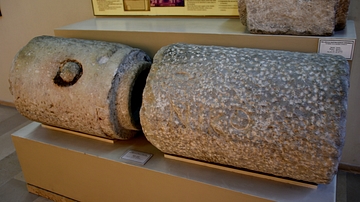
Inscribed Water Conduit from Beyazit
This is an inscribed water conduit with a bung. Marble. From Beyazit, modern-day Istanbul, Turkey. Fourth century CE. (Museum of Archaeology, Istanbul, Turkey).

Image
Gun-Boat Attack on the Water Batteries of Fort Donelson
The Gun-Boat Attack on the Water Batteries of Fort Donelson, wood carving print by an unknown artist based on a sketch by Alexander Simplot, 15 March 1862. The wood carving print shows a scene...

Image
God Separating the Land from the Water, Sistine Chapel
A panel from ceiling of the Sistine Chapel in the Vatican, Rome. The panel shows God separating the land from the waters. The ceiling was created between 1508 and 1512 CE by the Italian Renaissance...
Image
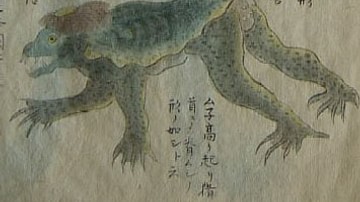
Japanese Kappa, a Water Sprite
Drawing of a Japanese kappa, supposedly caught in 1801 in Mito domain. Illustration from an 1836 copy by Reikai of Suiko Kōryaku by Koga Tōan. The inscription reads: Height 3.5 shaku, weight 12 kamme. The chest protudes...
