
Search Articles
Browse Content (p. 5)

Article
The Integration of Church and State in the Roman Empire
In the ancient world, "religion" and society were not separate entities. Various gods dictated covenants, "law-codes," and social conventions. Such law-codes were most often the responsibility of...

Article
Battle of Rich Mountain - The Victory That Created an Army
The Battle of Rich Mountain (11 July 1861), fought in Randolph County, Virginia (now West Virginia) was the second Union victory attributed to Major General George B. McClellan in the beginning...

Article
The History of the Inquisition - The Catholic Church's Battle Against Deviance
The Inquisition was the official institution of the medieval Catholic Church that established ecclesiastical judges to investigate and judge divergent opinions and practices that...

Article
Friedrich Gentz's Stance on the French Revolution - The Fusion of Berlin Enlightenment and British Conservatism
The story of the French Revolution is incomplete without the Prussian-Austrian diplomat and writer Friedrich von Gentz (1764-1832). It was Gentz who provided...

Article
Kesh Temple Hymn - The Oldest Work of Religious Literature in the World
The Kesh Temple Hymn (circa 2600 BCE) is the oldest work of religious literature in the world, sometimes referenced as the oldest extant religious poem. It is a Sumerian praise song...

Article
Poor Man of Nippur - What Does One Deserve?
The Poor Man of Nippur (circa 701 BCE) is a Babylonian poem on the themes of the obligations of hospitality and revenge for an undeserved injury. A poor man of the city of Nippur feels mistreated when he visits...

Article
Battle of the Coral Sea - First Aircraft Carrier Battle in History
The Battle of the Coral Sea, the first naval battle in history between aircraft carriers, took place between 4 and 8 May 1942 during the Second World War (1939-45). The Japanese navy hoped...

Article
The Nimrud Dogs - The Security System of Ancient Mesopotamia
The Nimrud Dogs, five clay canine figurines found at the ancient Mesopotamian city of Nimrud, were only a few of the many startling finds in the region in the 20th century. During the 19th century...

Article
Enlil in the E-kur - Praising God in Ancient Mesopotamia
Enlil in the E-Kur (circa 2000 BCE) is a Sumerian hymn praising the sky god Enlil, his temple/ziggurat at Nippur, and his consort Ninlil, depicting all three in glowing terms and Enlil as a creator...
Article
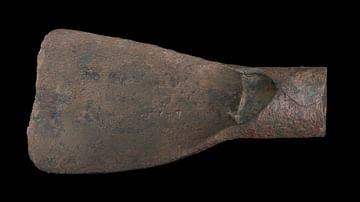
The Song of the Hoe - Praise for an Ancient Mesopotamian Farming Tool
The Song of the Hoe is a Sumerian praise poem celebrating the hoe for its many uses and linking it to the creation of the world by the great god Enlil. As the economy of Mesopotamia was...
