
Search Images
Browse Content (p. 1134)
Image
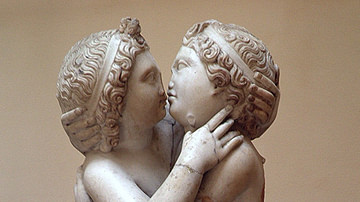
Statue of Cupid and Psyche
A detail of a marble statue of Cupid and Psyche from the Domus of Cupid and Psyche in Ostia Antica, Italy. The statue was made at the time the house was built, in the second quarter of the 4th century CE.

Image
Hall of Prayer For Good Harvests, Forbidden City
The Hall of Prayer for Good Harvests, part of the Temple of Heaven in the Forbidden City, Beijing. The temple and the Forbidden City were first built in the reign of Yongle Emperor of the Ming Dynasty...

Image
Yongle Emperor
A silk scroll portrait of the Yongle Emperor (aka Chengzu or Yung Lo, r. 1403-1424 CE) who was the third ruler of the Chinese Ming Dynasty (1368-1644 CE). (National Palace Museum, Taibei)

Image
Ming Dynasty Empire, c. 1409 CE
The Ming Dynasty Empire (1368-1644 CE) at the time of the Yongle Emperor (aka Chengzu r. 1403-1424 CE).
Image
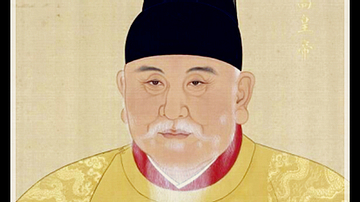
Ming Taizu, aka Hongwu Emperor
The Hongwu Emperor, the first emperor of the Ming Dynasty (1368 to 1644 CE) who reigned from 1368 to 1398 CE. 14th century CE painted silk hanging.
Image
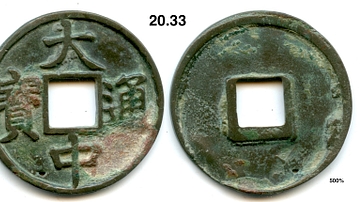
Coin of Zhu Yuanzhang
A bronze coin of Zhu Yuanzhang, the future Hongwu Emperor (r. 1368-1398 CE) who was the founder of the Ming Dynasty (1368-1644 CE).

Image
Kublai Khan Statue
A modern statue of the Mongol ruler Kublai Khan (l. 1215-1294 CE). Sukhbaatar Square, Ulaanbaatar, Mongolia.

Image
Marco Polo Statue
A sculpture depicting the Venetian explorer Marco Polo who famously travelled to China between 1271 and 1295 CE. (Villa Borghese, Rome)

Image
Map of Marco Polo’s Travels, 1271 - 1295
Marco Polo’s travels (1271–1295) represent one of the most famous European journeys into Asia during the late Middle Ages. Setting out from Venice with his father Niccolò and uncle Maffeo, Polo crossed through...

Image
The Court of Abd al-Rahman III
Abd al-Rahman III Receiving the Ambassador by Dionisio Baixeras Verdaguer (1862–1943 CE). Oil on canvas, 1885 CE.
University of Barcelona
