
Search Images
Browse Content (p. 1294)
Image
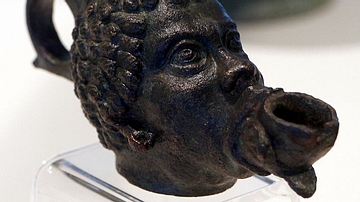
Bronze Oil Lamp in the Shape of an African Slave
This Roman oil lamp of unclear provenance was made in the 1st Century CE. It portrays an Aethiopian slave, with barbarians like Africans and Celts being popular motifs in Roman art. The lamp has also...

Image
Nile Mosaic of Palestrina
This mosaic was part of the floor of a grotto in Palestrina, near Rome, Italy. It dates to c. 100 BCE and is an example of the interest that Roman artists and elites began to take in Ptolemaic Egypt during the 2nd and...
Image
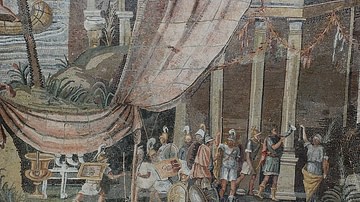
Roman Mosaic of Ptolemaic Soldiers
This scene is part of the Nile mosaic of Palestrina (c. 100 BCE), found in Palestrina, Italy. It portrays a group of Ptolemaic Greek soldiers in Egypt on the banks of the Nile. The soldiers are clad in typical Hellenistic...
Image
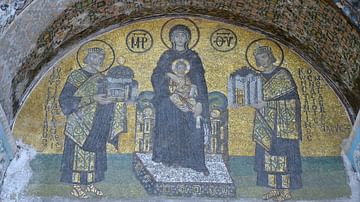
Mosaic with the Virgin Mary, Constantine and Justinian, Hagia Sophia
Mosaic panel located at the southwestern entrance of the basilica Hagia Sophia (Istanbul) depicting the emperor Constantine I holding a model of the city of Constantinople (right), the...
Image
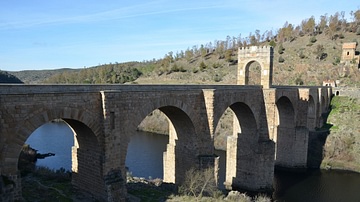
Alcántara Bridge
The Roman bridge at Alcántara in Extremadura, Spain, is one of the finest examples of Roman bridge-building and a monumental feat of engineering. It was built over the Tagus River in the ancient Roman province of Lusitania between...
Image
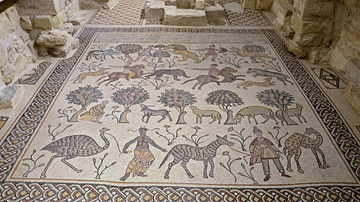
Mosaic in the Memorial Church of Moses, Mount Nebo
6th century CE mosaic in the Diakonikon Baptistry of the Memorial Church of Moses in Mount Nebo, Jordan. The mosaic, dating to 530 CE, is a large square divided into two sections. The top section depicts...

Image
Xerxes' Inscription, Van
The cuneiform inscription of Xerxes (486-465 BCE) on the rock cliffs of Van, a city on the shores of Lake Van, eastern Turkey. Written in the three official languages of the Achaemenid Empire: Old Persian, Elamite and...

Image
Vahagn the Dragon Slayer
A modern statue of Vahagn, the figure from Armenian mythology who was famed for his slaying of dragons and association with the Sun. Sculpted by Karlen Nurijanyan. Near Yerevan, Armenia.

Image
Miniature of Aethelflaed
14th century CE miniature of Aethelflaed, Lady of the Mercians (r. 911-918 CE), as found in the Genealogical roll of the kings of England.

Image
England Around 910 CE
Map showing England around 910 CE, showing among others the Viking territories under the Danelaw as well as the English kingdoms of Mercia (at this point in time ruled by Aethelred, Lord of the Mercians (r. 881-911 CE) and...
