
Search Images
Browse Content (p. 1308)
Image
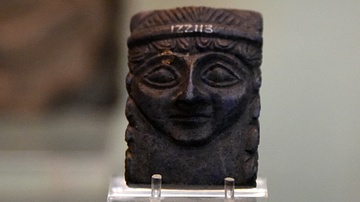
Lapis Lazuli Plaque in the Shape of a Woman's Face
This lapis lazuli inlay was carved in the shape of a woman's head and is quadrangular. The back is flat except for two straight incised lines continuing the line of the headband on the face. Height...
Image
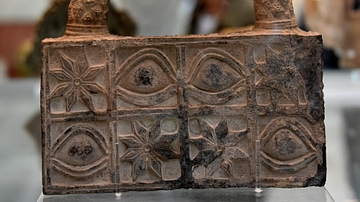
Mesopotamian Carved Stone with Integral Handle
This carved grey stone has an integral handle. It was possibly a weight. There are eight compartments decorated with the shapes of eyes and rosettes. The handle imitates basketry and is ornamented with...
Image
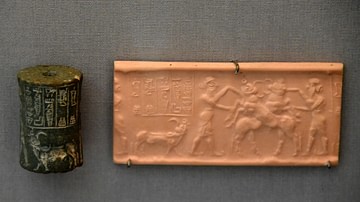
Cylinder Seal Showing a Contest Scene
This green jasper cylinder seal depicts a contest scene. At the centre of the scene, there is a pair of crossed bulls; each one is being attacked by a standing bearded hero. The heroes have a double bun hairstyle...
Image
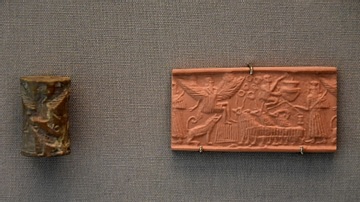
Myth of Etana Cylinder Seal
This calcite cylinder seal depicts the myth of Etana, the shepherd and the legendary king of Uruk, who was carried up to heaven by an eagle to obtain an heir. Etana's ascent is watched by the shepherd and his dog, with...
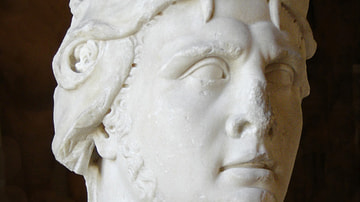
Image
Mithridates VI
Mithridates VI ruled Pontus and Armenia minor 120-63 BCE. Here, he is depicted as Heracles wearing the skin of the Nemean Lion. (Louvre Museum, Paris)

Image
Orontes II
Gold coin depicting Orontes I of the Orontid Dynasty, who ruled Armenia from 401-344 BCE. Coin dates to 362 BCE. (Bibliotheque National France)
There is some contradiction as to whether this is actually Orontes I or Orontes II.

Image
King Artavasdes II
Tetradrachm coin depicting King Artavasdes II, a member of the Artaxiad dynasty, who ruled the kingdom of Armenia from c. 56- c. 34 BCE.
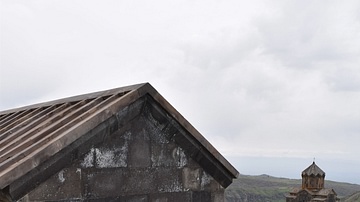
Image
Ruined Bathhouse and Vahramashen Church
Near Amberd Fortress are the ruins of bathhouses, which were popular among Armenia's elite in the Middle Ages. This bath, which is located near Vahramashen Church, was likely built in the 10th-11th centuries...
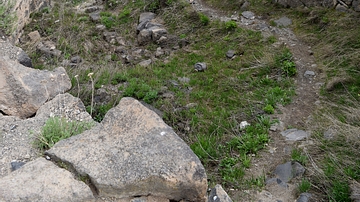
Image
Defense Walls of Amberd Fortress
Although the architecture of Amberd Fortress in what is present-day Armenia looks simple, its medieval walls were constructed from massive basalt tiles, which protected the fortress invasions and sieges. Some walls...
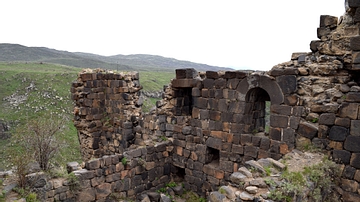
Image
Walls and Ruins of Amberd Fortress
Amberd Fortress, in the Aragatsotn province of Armenia, has a long and rich history. Its name translates as "fortress in the clouds" in Armenian, and it sits along the slopes of Mount Aragats at an altitude of 2300...
