
Search Images
Browse Content (p. 1335)
Image
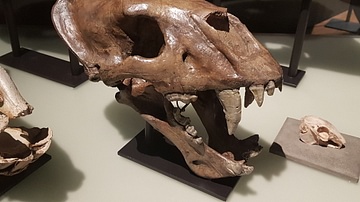
Homotherium Skull
Cast of the skull of a scimitar-toothed cat (genus Homotherium) which appeared across Africa, Eurasia and the Americas during the Pliocene (c. 5 million - c. 2,6 million years ago) and the Pleistocene (c. 2,6 million- c. 12,000...

Image
Clovis Spear Points
Stone spear points belonging to the Clovis industry which is associated with early modern humans (Homo sapiens) in North America between roughly 13,500-13,000 years ago. The so-called 'Clovis point' has a distinctively fluted...

Image
Solutrean Spear Points
Palaeolithic spear points belonging to the Solutrean industry which flourished in what is now southwestern France between c. 21,000-c. 17,000 years ago. They were made by early modern humans (Homo sapiens). Points shaped...
Image
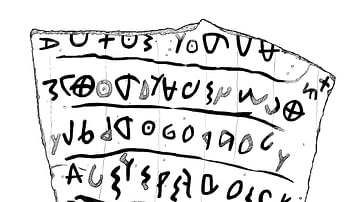
Khirbet Qeiyafa Ostracon
An illustration showing the markings of an ostracon (pottery sherd) from Khirbet Qeiyafa, Israel. The sherd is cited as evidence that the Hebrew language was in use from the 10th century BCE. The text has been interpreted...
Image
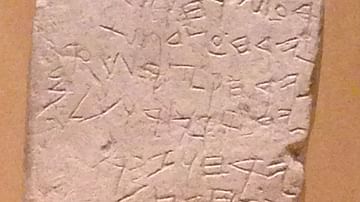
Gezer Calender
The Gezer Calendar stone. The stone, possibly dating to the 10th century BCE, carries an inscription in Phoenician or Hebrew outlining a series of dates and accompanying agricultural tasks. It was discovered and deciphered by R.A.S.Macalister...
Image
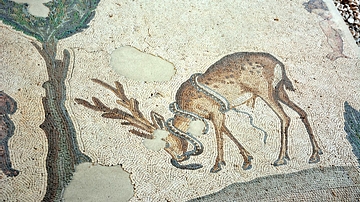
Stag & Snake, Byzantine Mosaic
The stag and the snake mosaic: In some ancient texts, the stag is seen as a rival to the snake. It can also draw a snake out of its hole with its breath. The deer was a symbol of fertility and the animal of Artemis...
Image
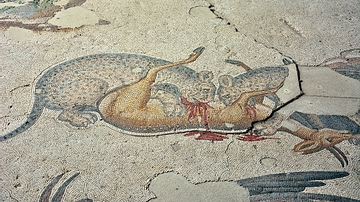
Leopards Hunting Deer, Byzantine Mosaic
Leopards hunting a deer, Byzantine Mosaic, Period: Early Byzantine, circa: 6th century CE. Place: Constantinople, (Modern Istanbul, Turkey). Great Palace Mosaic Museum, Istanbul, Turkey. The Great Palace Mosaic...
Image
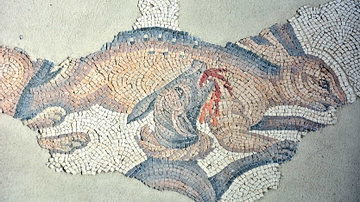
Hunting Rabbits, Byzantine Mosaic
Hunting Rabbits: The dogs are attacking the rabbit on its neck and abdomen. The hunter is depicted having just released the dogs, Byzantine Mosaic, Period: Early Byzantine, circa: 6th. century CE. Place: Constantinople...

Image
Man Feeding Mule, Byzantine Mosaic
A man is feeding his mule, Byzantine Mosaic, Period: Early Byzantine, circa: 6th century CE. Place: Constantinople, (Modern Istanbul, Turkey). Great Palace Mosaic Museum, Istanbul, Turkey. The Great Palace Mosaic...

Image
Philosopher, Byzantine Mosaic
A philosopher sitting on a rock. Byzantine Mosaic, Period: Early Byzantine, circa: 6th century CE. Place: Constantinople, (Modern Istanbul, Turkey). Great Palace Mosaic Museum, Istanbul, Turkey. The Great Palace...
