
Search Images
Browse Content (p. 1359)

Image
Emperor Aurelian & Sasanid Archers
Artist's impression of Emperor Aurelian (r. 270-275 CE) in battle with Sasanid archers, as depicted in the PC game Rome II: Total War - Empire Divided.
Image
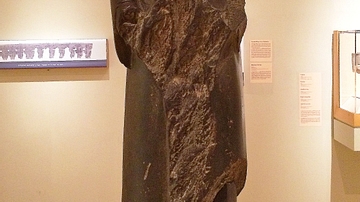
Statue of the Egypto-Persian Ptahhotep
This statue of Ptahhotep (who was the Overseer of the Treasury) is shown in a Persian costume that Egyptian officials adopted when Egypt was under Persian control. The jacket with flaring sleeves, over which...
Image
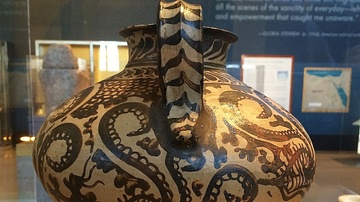
Minoan Decorated Jug Found in Egypt
One of the world's most famous works of Minoan pottery, this vessel shows five mollusks called nautili floating above the seafloor. The sinuous undulating lines of the water plans and nautili tentacles clearly...

Image
Floral Frieze from Ancient Egypt
Although the use of glazed tiles and colored paste inlays is known from as early as the Old Kingdom, the apogee of their use came during the New Kingdom. An almost identical frieze of lotuses, other flowers, and grape...
Image
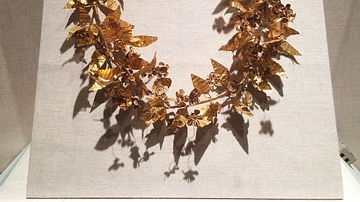
Ptolemaic Gold Wreath
Wreaths like this one formed to resemble flowers and leaves were used to crown athletic victors throughout the ancient Greek world. The Egyptian-born Greek writer Athenaeus of Nitocric (c. late 2nd-3rd century CE) tells of...
Image
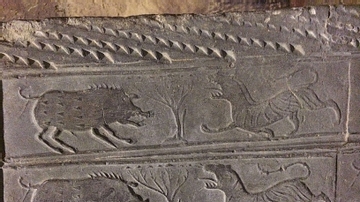
Ancient Chinese Brick
This is an ancient Chinese brick from a tomb doorway, which was created during the Han Dynasty (206 BCE-220 CE) and made from clay. This brick depicts dueling boars and tigers. (Victoria & Albert Museum, London)
Image
Ancient Chinese Brick from Tomb Doorway
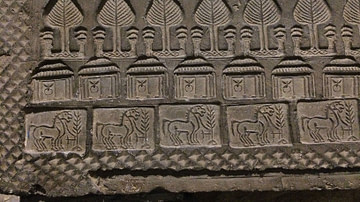
This is an ancient Chinese brick from a tomb doorway, which was created during the Han Dynasty (206 BCE-220 CE) and made from clay. This brick shows trees, tomb doorways, and tethered horses. (Victoria & Albert...
Image
The Symmachi Panel
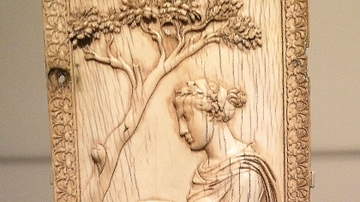
The interest in ancient Roman religions continued for several decades after Christianity became the official religion of the empire. At the end of the 4th century CE, it was actively revived by senatorial families like the Symmachi...
Image
Basil II in Triumph
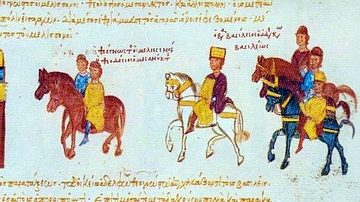
A 12th century CE depiction of the Byzantine emperor Basil II (r. 976-1025 CE) riding in triumph through Constantinople. From the Madrid Skylitzes. (National Library of Spain, Madrid)

Image
Psalter of Basil II
An early 11th century CE depiction of Byzantine emperor Basil II (r. 976-1025 CE) being crowned and armed by archangels. He is being blessed by God from above and worshipped by military saints on both sides. Below, courtiers...
